

When I compared Gartner’s AI Hype Cycles for 2024 and 2025, generative AI’s descent towards disillusionment was the obvious story. The excitement was meeting the expense of implementation. I treated that as a broadly healthy transition.
Looking across three editions, I would qualify that optimism. Disappointment can prompt better engineering. It can also expose a project that should never have been funded. Time does not settle the difference.
Gartner’s 2026 edition, published on 28 August, arrives with investment still strong and value uneven. Its summary also broadens the agenda towards user experience and integrated hardware and software. AI’s ambitions keep growing; turning them into dependable services remains an unfinished task.
This comparison draws on Gartner’s public summaries and commentary, rather than reconstructing every technology’s position on the three charts.
2024 and the first warning about value
The 2024 report already contained a warning that is easy to overlook in retrospect. Investment had reached a new high, concentrated on generative AI, but the anticipated business value had largely yet to materialise. Gartner encouraged leaders to consider a wider range of AI techniques.
So 2024 was more complicated than collective enthusiasm. The tension between impressive capability and disappointing returns was already visible.
My reading is that the strategic mistake was allowing one category to stand in for the whole field. Once “AI strategy” becomes shorthand for “where shall we put a language model?”, the choice of technology precedes the definition of the problem.
Consider a hypothetical retailer trying to reduce stock shortages. Generating fluent explanations of inventory reports might help its managers. Forecasting demand, improving replenishment rules or fixing unreliable stock records could address the shortage more directly. Those are different interventions, with different tests of success.
The lesson from 2024 survives the changing model names: a compelling interface can attract investment away from a less glamorous problem worth solving.
2025 and the return of the foundations
In its public explanation of the 2025 cycle, Gartner placed generative AI in the Trough of Disillusionment. AI agents and AI-ready data occupied the Peak of Inflated Expectations. AI engineering and ModelOps, the discipline of managing models throughout their operational lives, received greater attention.
That combination is revealing. Enthusiasm for autonomy was rising alongside recognition of the preparation required to make AI useful. Data being “ready” means being suitable for a particular use, with the quality and context that use demands.
For our hypothetical retailer, an assistant might now retrieve stock information and propose a replenishment order. But which stock figure should it trust? How recently was it updated? Does “available” include goods already promised to another customer?
A stronger model cannot decide which business record is authoritative unless the organisation supplies that distinction. Connecting an assistant to more systems can simply give it more contradictory information.
I read 2025 as the year the supporting work became harder to ignore. The glamorous part was the agent. The consequential part was making its inputs and operating environment dependable.
2026 and the consequences of delegation
Gartner’s October 2026 commentary shifts attention towards accountability, application reliability and costs. It highlights AI observability: the ability to inspect behaviour and detect failures, including plausible but incorrect outputs. It also stresses that observability tools and AI cost-management capabilities remain immature.
This introduces an awkward tension. Organisations need controls to expand their use of AI, yet the products intended to provide those controls are themselves still developing.
Return to the retailer. Suppose its agent can now place orders within an agreed limit. The question changes again. Someone needs to know which record justified a purchase, whether the supplier accepted it, and what happens if the system retries after receiving an ambiguous response.
A successful demonstration might show one correct order. A credible operating design must also explain how it prevents duplicate orders and how it investigates a disputed transaction.
These are illustrative stages, not a claim that every retailer followed this timetable. They show why greater capability can increase the work required around a system. Delegating an action creates obligations that generating a suggestion does not.
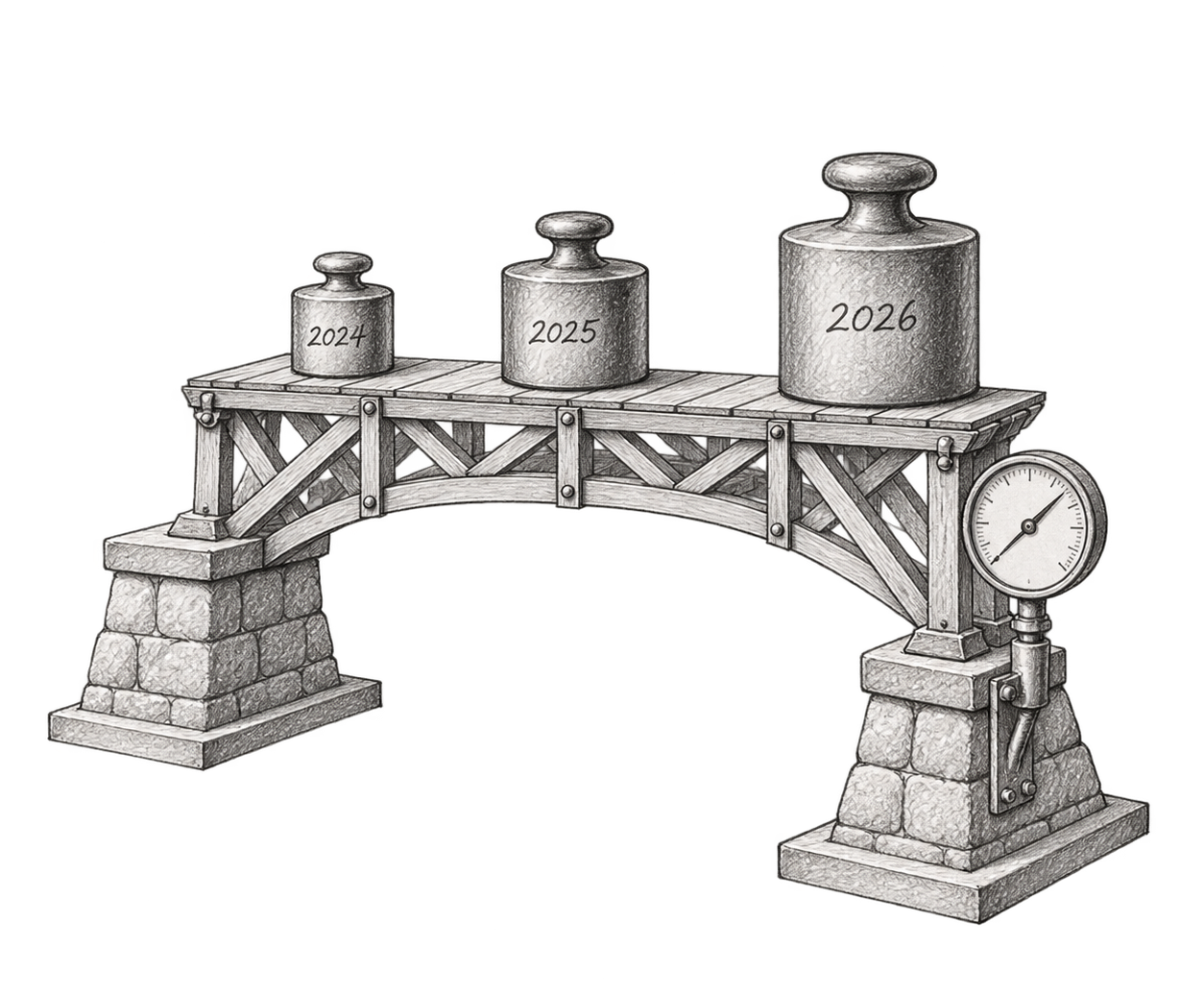
My interpretation of the three editions is therefore straightforward.
In 2024, investment in generative AI was outpacing demonstrated value. Leaders asked whether they had chosen the right technique for the problem.
In 2025, attention shifted towards the foundations needed to scale AI, alongside growing enthusiasm for agents. The question became whether the organisation’s data and operations could support the proposed use.
By 2026, accountability, reliability and financial control had become more prominent. The question grew more demanding: can we supervise the actions we are delegating?
Progress does not guarantee a return
The attraction of the Hype Cycle is that it gives confusion a recognisable shape. Its danger is that the shape can make eventual success feel inevitable.
I would resist treating a technology’s position as an instruction to buy, wait or abandon it. A broad assessment of expectations cannot determine the economics of a specific workflow. Two organisations can use the same model and face entirely different costs because their information, customers and tolerance for mistakes differ.
Nor should disappointment automatically trigger a search for the next fashionable category. Replacing a chatbot proposal with an agent proposal leaves the original investment question unanswered unless the additional autonomy solves something valuable.
For the retailer, the useful evidence would concern stock availability, purchasing errors and total operating cost, including the people handling exceptions. More generated reports or more autonomous actions would tell us little on their own.
That is the change I see most clearly between 2024 and 2026. The burden of proof expands with the ambition of the deployment. A model demonstration can earn an experiment. Reliable performance can earn a larger role. Permission to act on the organisation’s behalf should require evidence proportionate to the consequences.
The next edition will move the dots again. An investment case should already know what would make us change our minds.