

The European Union has made its most ambitious commitment yet to artificial intelligence (AI), announcing a €50 billion public funding initiative to bolster the bloc’s AI ambitions. This move, revealed by European Commission President Ursula von der Leyen at the Paris AI Summit, aims to mobilise a total of €200 billion when combined with €150 billion in private investments from leading companies such as Airbus, ASML, Siemens, Infineon, Philips, Mistral, and Volkswagen.
While significant, this funding pales in comparison to the United States’ aggressive AI push. Under the Trump administration, U.S. private sector investments in AI infrastructure have surged to $500 billion. Meanwhile, China is rapidly expanding its AI capabilities, combining state-backed strategic investments with dominance in key sectors such as semiconductors, high-speed computing, and cloud infrastructure.
Europe’s Strategic AI Playbook
Europe has historically lagged behind in the global technology race, particularly in consumer digital platforms, cloud computing, and AI development. However, the latest wave of AI presents a different opportunity—one that could allow Europe to take a leadership role in mission-critical AI applications, industrial automation, and responsible AI governance.
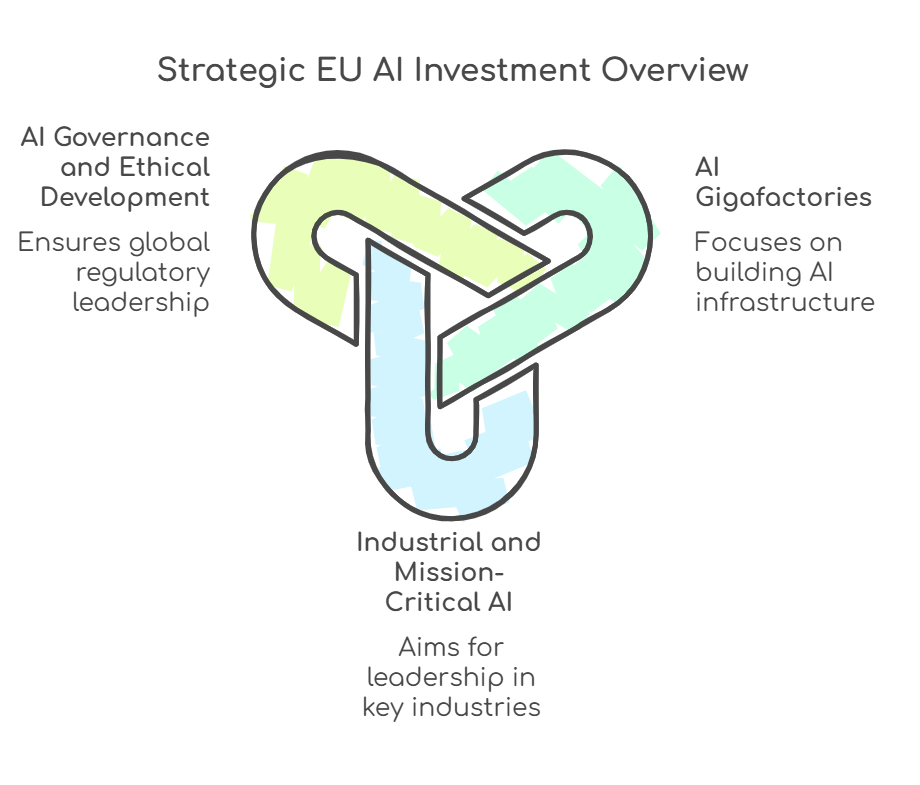
The €50 billion EU investment will prioritise three key areas:
AI Gigafactories: €20 billion will be dedicated to constructing four AI gigafactories across Europe, adding to the seven announced in December 2024. These facilities will serve as hubs for developing next-generation AI models and computing infrastructure.
Industrial and Mission-Critical AI: Unlike the U.S., which focuses heavily on consumer applications, Europe aims to lead in AI for manufacturing, healthcare, financial services, and public sector applications.
AI Governance and Ethical AI Development: The EU is shaping global regulatory frameworks to ensure AI transparency, fairness, and accountability. This approach contrasts with the more laissez-faire U.S. model and China’s state-controlled AI ecosystem.
The European AI Competitive Landscape
Despite ambitious plans, Europe faces major challenges:
Capital and Talent Flight: Europe’s AI sector struggles to retain top talent and attract sufficient venture capital compared to Silicon Valley or China. The gap in AI startups valued over $1 billion (unicorns) remains stark.
Regulatory Complexity: While AI regulation is necessary, European tech executives argue that excessive bureaucracy and compliance requirements are discouraging investment. In contrast, the U.S. and China offer more flexible regulatory environments.
Infrastructure Bottlenecks: The EU’s fragmented AI and semiconductor supply chains pose a risk to scaling AI innovations. Without significant improvements in compute infrastructure and chip manufacturing, Europe’s AI sector could struggle to compete globally
The Global AI Investment Race
The AI investment landscape is increasingly geopoliticised. In Davos 2025, European leaders expressed concern over losing ground to the U.S. and China, with American business leaders openly stating that Europe’s AI sector remains "uninvestable" due to regulatory constraints. At the same time, China has been making rapid progress in AI dominance, particularly in high-performance computing, semiconductors, and AI-driven industrial automation.
The EU’s AI investment signals a shift towards technological self-reliance and strategic autonomy. However, whether it will be enough to close the gap remains uncertain. For Europe to become an AI powerhouse, it must not only fund innovation but also foster an environment that attracts global AI talent, scales successful startups, and ensures that AI-generated economic value stays within its borders.
A Call for Bold Action
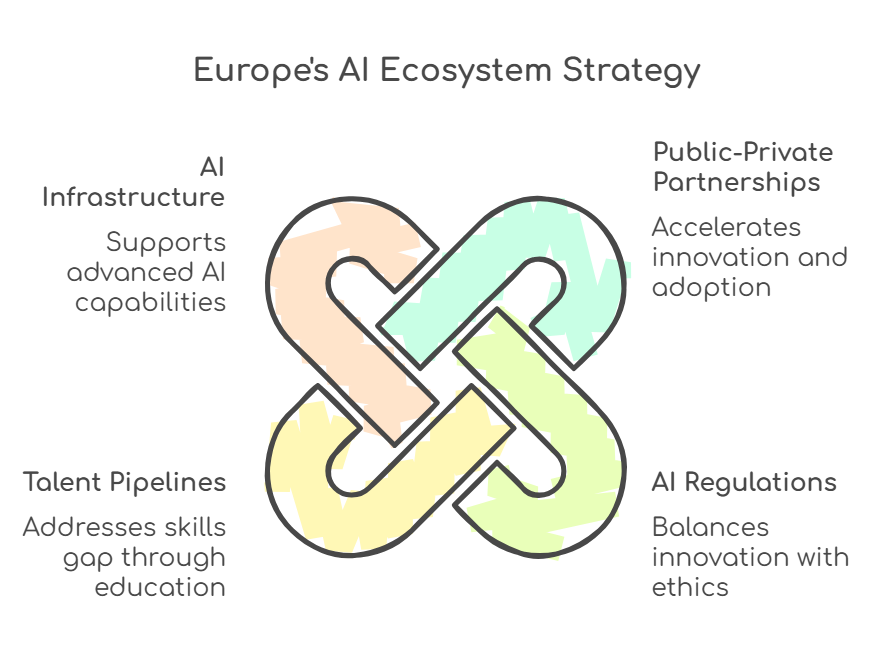
If Europe wants to lead in AI, it must go beyond investment—it must rethink its entire AI ecosystem. This includes:
Strengthening AI public-private partnerships to accelerate innovation and commercial adoption.
Streamlining AI regulations to balance innovation with ethical considerations without stifling growth.
Building AI talent pipelines through education and reskilling initiatives to close the skills gap.
Enhancing AI infrastructure by increasing investments in semiconductor manufacturing, cloud computing, and supercomputing capabilities.
The global AI race is heating up, and Europe must decide whether it wants to be a leader or a follower. The coming years will be crucial in determining whether the EU can turn its AI ambitions into reality or whether it will remain a secondary player in the rapidly evolving digital economy.
Sources:
Foo Yun Chee. (2025, February 11). EU's AI push to get 50 billion euro boost, says von der Leyen. Reuters.
General Catalyst. (2025, February). An ambitious agenda for European AI.
RBC Thought Leadership. (2025, January). Davos 2025: Searching for nuggets in the new golden age.
European Commission. (2024, September). The future of European competitiveness: In-depth analysis and recommendations.
European Commission. (2024, September). The future of European competitiveness: A competitiveness strategy for Europe.