

Imagine you’re piloting a rocket. You can choose brilliance: flashy manoeuvres, dramatic loops, dazzling altitude. Or you can choose dependability: steady ascent, no surprises, arriving exactly on schedule. In the world of AI, we too face that choice.
We’re witnessing an explosion of AI agents in the wild. According to PwC, 79 % of organisations already deploy AI agents in some capacity. And 88% of companies plan to increase their AI budgets this year, driven by this shift.
Sources: Tech Monitor and PwC
Meanwhile, forecasts project the AI agent market to soar from $3.7 billion today to $103.6 billion by 2032, representing a staggering compound annual growth rate of 44.9%. Some early adopters trumpet results like 170x ROI, 40% gains in productivity, and 30% cost reductions.
Those numbers are bold. But here’s the secret: they’re not driven solely by Intelligence. Trust drives them.
The Illusion of Intelligence
“Intelligence” is seductive. It promises systems that think, reason, and surprise us with creativity. In demos, intelligent agents dazzle, anticipating questions, proposing novel strategies, adapting on the fly.
But in the real world, intelligence can be brittle. It might work brilliantly in a controlled pilot, but break under scale, edge cases, data shifts, or at 2 AM when a crisis hits. Intelligence without guardrails creates risk, inconsistency, and unpredictability.
Why Reliability Wins in Practice
Reliability means consistency, transparency, fallbacks, and repeatability. It means your systems aren’t perfect—but they always behave in acceptable bounds. The kind of AI a CEO can trust with customer experience, revenue operations, or mission-critical workflows.
Think: a model that occasionally “hallucinates” is dangerous. But one that is predictable, with safety checks, versioning, monitoring, and failovers, that is what leadership bets on.
Every headline ROI claim is built on reliability. The 40 % productivity boost? Only possible when the AI runs continuously, across multiple use cases, without failures. The 170× ROI? Only achievable when adoption scales across departments, not just in a pilot.
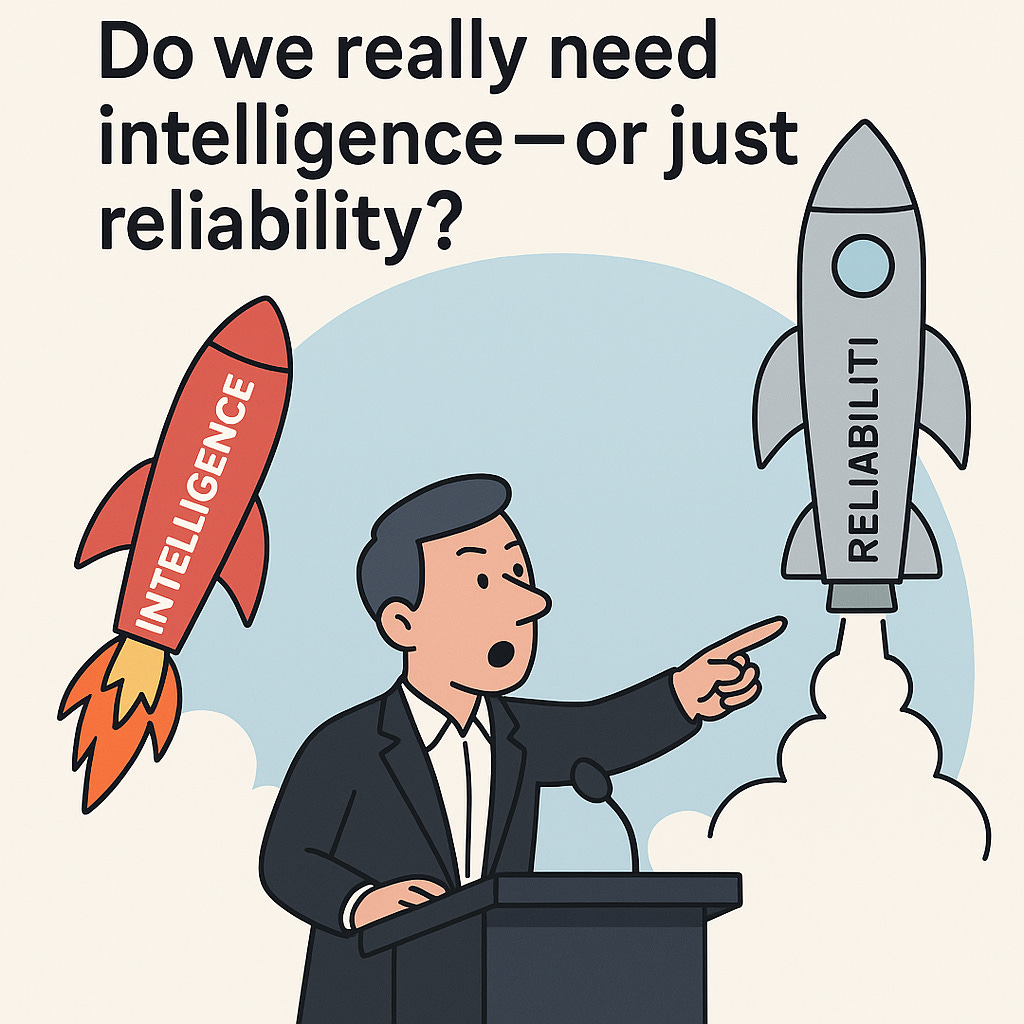
When you ask, “Do we need intelligence or just reliability?”, the answer becomes clearer: intelligence is the aspiration; reliability is the foundation.
A Vision for C-Suite Leadership
Set trust as a design goal. Before chasing “smarter” agents, an architect for observability, explainability, guardrails, and human oversight.
Pilot for reliability first. Validate consistency in the edge cases, under load, in real-world messy data. Don’t start with deep creative tasks; start with core operational flows.
Scale with confidence. Once agents prove stable, incrementally unlock more intelligent behaviours. But never at the cost of trust.
Align incentives around uptime, not wow. Reward teams for resilience, error reduction, and user adoption—not just for impressive demos.
Communicate for executives & users. Use clear dashboards, metrics, and SLA reports. Visibility builds confidence across the organisation.
The Legacy You’ll Choose
Years from now, when people ask, “Who built the world-changing AI platform?”, what do you want them to say?
The leader who built the flashiest, smartest agents?
Or the leader who built the most dependable engine of innovation, the one that ran 24/7, never failed, became the backbone of operations?
In the grand arc of transformation, intelligence dazzles, but reliability endures.
So when your next AI decision comes, when you are asked for “smarter agents”, you’ll already know: intelligence is exciting, but reliability is the real premium.