

Each year, Davos gathers the world’s most influential leaders in business, politics, and academia under the banner of the World Economic Forum (WEF). The 2025 edition marks a critical inflection point and urges for “Collaboration in the Intelligent Age”. As artificial intelligence reshapes industries, economies, and societies, Davos is no longer just about economic strategies and geopolitical tensions. It is about the existential choices we must make as a civilization.
The Shifting Narrative at Davos
For decades, Davos has been a stage for high-level discussions on financial markets, trade policies, and sustainability. But in recent years, AI has surged to the forefront, not just as a topic, but as an unavoidable force driving every sector. No longer a distant promise, AI is today’s most powerful instrument of transformation, capable of unlocking unprecedented efficiencies, but also exacerbating inequality, job displacement, and ethical dilemmas. The conversation at Davos has shifted from “How can we leverage AI?” to “How do we govern AI for collective good?”
AI as a Geopolitical and Economic Power
Countries and corporations alike are racing to lead in AI development. The United States and China dominate the space, but Europe, the Middle East, and emerging markets are intensifying their focus on AI sovereignty. The global AI race is not just about technological prowess—it is about economic dominance, digital ethics, and strategic autonomy. Nations that master AI will wield influence over global markets, security, and even cultural narratives.
The central theme at Davos 2025 is not merely “who owns AI” but rather “who collaborates on AI.” In an era where algorithms cross borders faster than regulations, global AI governance cannot be unilateral. The collaborative age of AI demands cooperative frameworks, not isolated regulatory silos.
Corporate Leaders and the Responsibility Revolution
CEOs at Davos are no longer just talking about AI as an efficiency booster. They are being called upon to answer fundamental questions: How will AI impact workers? How can companies mitigate bias and ensure ethical deployment?
CEOs remain optimistic about AI and increasingly view it as an engine for growth. They see AI as a transformative force capable of enhancing productivity, improving customer experiences, and driving innovation. However, optimism must be tempered with responsibility. Ethical AI is not a PR strategy; it is a business imperative. From finance to healthcare, AI-driven decision-making needs transparency, accountability, and human oversight. The companies that invest in explainable AI, workforce upskilling, and collaborative innovation will shape the future economy. Those that prioritize short-term gains over societal stability risk regulatory crackdowns and public distrust.
The Intelligent Age and the Business Strategy Shift
Driven by rapid advancements in AI, quantum computing, and blockchain, the Intelligent Age is transforming everything, everywhere, all at once. Industries have had to adapt their business strategies to account not only for these major technological shifts but also seismic geo-economic shifts. The challenge is no longer just about adopting AI; it is about integrating AI, quantum, and decentralized technologies into core business models while balancing short-term performance and long-term imperatives.
AI and the Future of Work: The Urgency of Reskilling
One of the most pressing issues at Davos is AI-driven job displacement. The immediate question is not just “which jobs will AI replace?” but “how do we ensure a just transition?”
Future adoption rates would depend on how tasks are augmented or automated by AI. The figure below shows predictions by industries of the tasks that could potentially be augmented or automated.
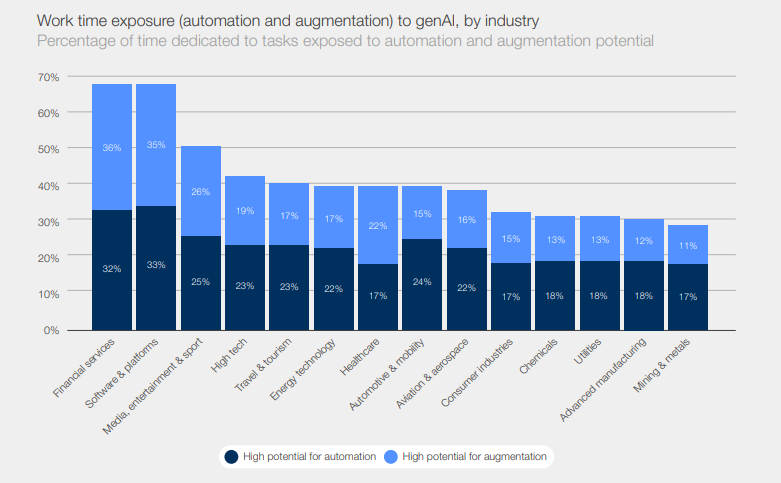
Source: AI in Action: Beyond Experimentation to Transform Industry (World Economic Forum, 2025)
Governments, corporations, and educational institutions must align on reskilling initiatives. AI will create new roles, but without large-scale workforce adaptation, the labor market will fracture. The AI Collaborative Age demands that leaders move beyond rhetoric and implement real solutions—policy incentives for lifelong learning, corporate-funded training programs, and international AI labor agreements.
The Call for Global AI Governance
Davos 2025 saw intense discussions on AI governance. Fragmented national policies will not suffice in a world where AI operates without borders. The risk of regulatory divergence—where one nation’s lax laws create risks for all—is too great.
A Global AI Framework, similar to international trade agreements, is no longer optional. Davos presents a rare opportunity: a neutral ground where AI superpowers and emerging economies can negotiate fair standards. Transparency, ethical AI principles, and accountability mechanisms must be at the core of these discussions.
AI as a Force for Inclusion and Sustainability
Amidst concerns of bias and displacement, AI also holds immense potential for social good. Leaders at Davos discussed that AI can leverage inclusion, climate action, and public health. AI-driven solutions in renewable energy, precision medicine, and disaster prediction could redefine sustainability. However, as highlighted in AI in Action: Beyond Experimentation to Transform Industry, while many organizations have experimented with AI through pilots, scaling these efforts for sustained impact remains a major challenge. Without a concerted effort to integrate AI for public benefit, these advancements risk remaining locked within elite institutions and tech conglomerates.
The Davos Imperative: Lead or Be Led
The AI Collaborative Age is not a future scenario—it is today’s reality. Leaders have a choice: shape the global AI agenda or watch as fragmented, conflicting policies emerge in its absence. The leaders who rise to this occasion will not be those who merely regulate AI, but those who harness its power for the collective good.
The message is clear: AI is no longer an industry topic—it is the defining issue of our time. The era of AI collaboration has begun. Will leaders step up?