

The GPT Store is not an app store. It’s a behaviour store.
If you skim the public, brand-associated GPTs in the GPT Store, one thing jumps out: they are not “chatbots”. They are packaged behaviours.
Some behaviours are light (a themed recommender). Others are heavy (connected to live catalogues via actions/APIs). And the interesting part is not the UI. It’s the business function the behaviour replaces:
the first ten minutes of browsing
the “I don’t know what I want” moment
the messy brief that never becomes a plan
the blank page before a design exists
the overwhelming inventory where the user quits
The pattern is clear: recommendation, planning, and creation dominate across travel, commerce, outdoor, and content tools.
This matters because GPTs don’t just sit on top of your funnel. They reshape it.
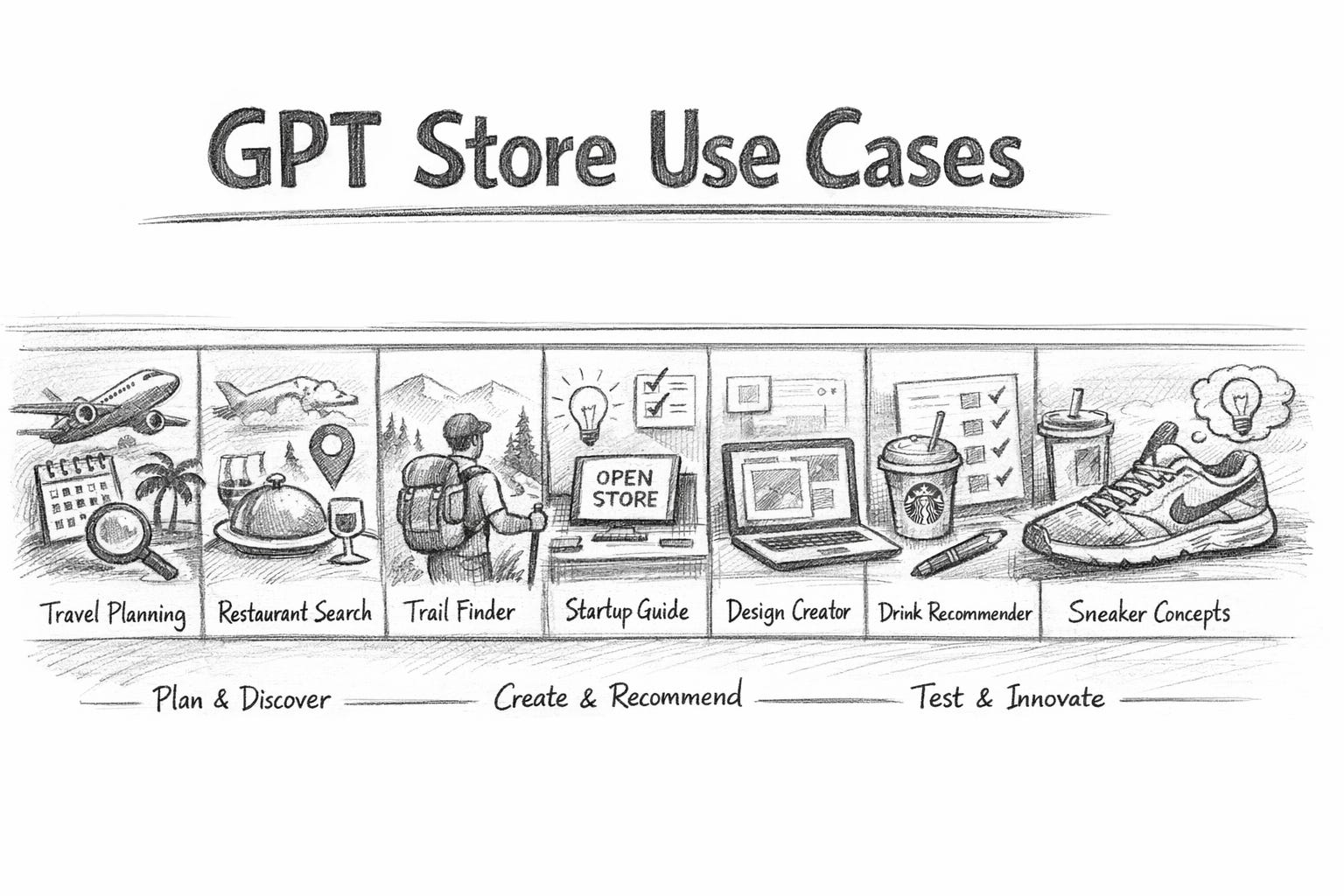
Brand GPT use cases that are already live (and what they really do)
1) Travel planning GPTs: turning “inspiration” into a structured basket
Expedia and KAYAK show the most commercially obvious behaviour: compressing planning time.
What the GPT does in practice
Converts vague intent (“a warm break in April under €1,200”) into structured constraints (dates, airports, duration, hotel style).
Produces ranked options fast enough to keep the user in flow.
Hand it off to the brand’s ecosystem for the final booking step (even if checkout stays outside ChatGPT).
Why is this strategically strong?
Travel is an anxiety category: too many options, high perceived regret, high price volatility. A GPT is a regret-reduction interface.
The winning feature isn’t “better recommendations”. It’s constraint discovery. The GPT elicits what users fail to type into search filters (tolerance for layovers, neighbourhood vibe, hotel priorities, hidden constraints like “must be walkable”).
Expedia has even published an MCP server exposing a travel recommendations service (hotels, flights, activities, cars), which is basically the “action layer” these assistants need to feel real.
2) Restaurant discovery GPTs: triage before reservation
The OpenTable-like GPT in the table is especially instructive because it highlights a governance problem: brand experience can be created without the brand.
What the GPT does
Narrows a universe of venues using conversational taste (occasion, noise level, dietary constraints, “somewhere that feels like…”).
Moves users from browsing to a shortlist.
Why is this strategically strong?
Restaurants are “small decision, high emotion”. A GPT acts as a taste translator.
This category exposes the difference between branded intent and branded control. If you don’t publish an official GPT, someone else can publish the behaviour anyway, often with weaker data hygiene and higher confusion risk.
3) Outdoor planning GPTs: search becomes a query language
AllTrails is the cleanest example of an “actions-powered” GPT in your report.
What the GPT does
Takes “I want a 90-minute run near Utrecht, not too flat, preferably a loop” and converts it into searchable parameters.
Returns a list that feels personalised without forcing the user to learn a filtering UI.
Why is this strategically strong?
It turns natural language into structured retrieval. That is the core value of GPTs for catalogue businesses.
The GPT is effectively a new query layer for your database. It’s not competing with your app; it’s changing how people ask for inventory.
4) Entrepreneurship guidance GPTs: turning ambiguity into a checklist
Shopify Sidekick sits in a different bucket: it’s not mainly discovery. It’s execution guidance.
What the GPT does
Converts “I want to start selling X” into next steps: positioning, pricing, store setup, product pages, and basic marketing.
Reduces tool switching and decision fatigue.
Shopify positions Sidekick as an assistant inside the admin that helps you start, run, and grow a business.
The real ROI is not advice. It’s momentum. Sidekick helps users keep moving through friction points where churn usually happens (setup steps, configuration fear, “I’ll do it later”).
5) Design/creative GPTs: compressing the first draft cycle
Canva is the clearest “blank-page killer” in the set.
What the GPT does
Produces draft layouts, templates, and content variants quickly.
Shifts the user from “create” to “edit”, which is a lower-friction mental state.
This is not about replacing designers. It’s about moving non-designers into a usable draft that designers can refine—or that is “good enough” for internal work.
6) Brand menu recommendation GPTs: personalisation without personal data
Starbucks-themed GPT behaviour is simple: suggest a drink. But its strategic value is subtle.
What the GPT does
Translates preferences (“not too sweet, iced, coffee-forward”) into a menu item.
Encourages discovery and upsell (“try this with…”).
Menu recommendations are a safe testing ground for GPT behaviours because the consequences of failure are low, and “personalisation” can be done with session context rather than identity.
7) Concept product design GPTs: marketing R&D without the factory
The Nike-themed sneaker concept GPT in your table is not official, which is precisely why it’s so useful as a signal.
What the GPT does
Generates photorealistic concept designs.
Let’s communities prototype aesthetics at internet speed.
Even if the brand never ships the shoe, this behaviour can generate trend intelligence: silhouettes, colourways, cultural references that resonate.
It also highlights the IP question: unofficial GPTs can blur what is “fan-made” vs “brand-made”, which can become reputational debt.
The three patterns behind every successful brand GPT
Across the eight examples, the winning GPTs usually do one (or more) of these:
Translate intent into structure
Natural language → filters, parameters, ranked lists.Shrink the “time-to-first-output”
A plan, a shortlist, a draft, a checklist—fast.Hand off to a trusted action layer
The GPT is the conversation. The brand system is the truth (catalogue, inventory, account, booking flow).
The GPT Store announcement itself frames the platform as a marketplace of specialised GPTs and categories, reinforcing that discovery and usefulness (not novelty) is the game. (OpenAI)
A practical playbook for executives: what to do next week
Step 1: Choose your “behaviour wedge”
Pick one behaviour that is both valuable and bounded:
Catalogue query layer (travel, trails, products, venues)
Onboarding momentum (setup, configuration, guidance)
First-draft machine (templates, decks, landing pages, ads)
Avoid “general brand assistant”. It sounds safe, but it’s usually useless.
Step 2: Decide the action boundary (what the GPT can touch)
There are three maturity levels:
Level 0: Themed guidance (no actions)
Level 1: Read-only actions (search, recommendations, status)
Level 2: Write actions (create, modify, book, purchase) — only with explicit approvals
Most brands should start at Level 1: it feels real, but the blast radius is contained.
Step 3: Build for “constraint discovery”
The prompt and conversation design should force the right questions:
budget, dates, location flexibility
must-haves vs nice-to-haves
hidden blockers (kids, accessibility, time windows)
This is where GPTs beat traditional UI.
Step 4: Treat unofficial GPTs as competitive intel
Search the store for your brand name and log:
who built it
what it does
where it might mislead users
what it reveals about user demand
Then decide: remove, ignore, or outcompete with an official experience.
Step 5: Put data and disclosure in plain English
If actions send user input to your systems, make that clear.
Don’t bury it in policy language. A GPT is an intimacy interface; users assume it’s private unless told otherwise.
Distribution shifts from apps to answers
The GPT Store should be read as a signal: major platforms are racing to own the interface where decisions start.
Brands that win here won’t be the ones with the cleverest personality. They’ll be the ones that:
turn conversation into structured outcomes,
connect to real inventory safely,
and reduce customer effort so much that it feels like cheating.
That is what the best use cases already demonstrate.