

This morning, at Devoteam Fusion 2026 at Lisbon’s Champalimaud Foundation, I kept hearing two apparently incompatible instincts.
One was: be careful. Artificial intelligence is moving into decisions, workflows and infrastructure where errors have real consequences.
The other was: be much bolder. Stop experimenting forever. Put things into production. Learn by doing.
Sebastien Chevrel | Group Managing Director, Devoteam
Appropriately, the event even included an interactive generative-art installation called “Where do you stand?”, asking participants to position themselves between Human and Machine, Trust and Scepticism, Control and Autonomy.
Judging from the conversations on stage, the answer was: everywhere at once.
What struck me most was not disagreement about whether AI matters. That debate is over. The disagreement is about how fast organisations should move now that it does.
And here, corporate reality still feels surprisingly cautious.
There was plenty of discussion about proofs of concept, experimentation and promising use cases. Much less about genuinely significant deployments operating at scale. Even organisations that have been working with AI for years still seem to be navigating the gap between an impressive prototype and something embedded deeply enough in the business to change how it operates.
Then there is money.
The cost of tokens and inference surfaced repeatedly as a concern. That is healthy: once AI leaves the demo environment, usage becomes an operating expense. Agents can call models many times, invoke tools, retry tasks and generate costs that barely exist in a controlled pilot.
But there is a danger that perfectly legitimate questions about unit economics become another reason to postpone learning what only production can teach.
That tension became particularly visible during the Utopia & Pragmatism panel, which brought together Caixa Geral de Depósitos, Vodafone and Luís Viegas Cardoso, AI Gigafactory Lead at Banco Português de Fomento.
Cardoso effectively gave Vodafone and CGD a public nudge: move faster.
It landed because of where he is coming from. Portugal is part of an Iberian bid for one of Europe’s new AI Gigafactories, infrastructure designed for AI at industrial scale, not another corporate sandbox.
We are discussing infrastructure with more than 100,000 advanced AI processors while many companies are still deciding which pilot deserves to become a product.
That gap is becoming difficult to ignore.
But speed without rules creates another problem.
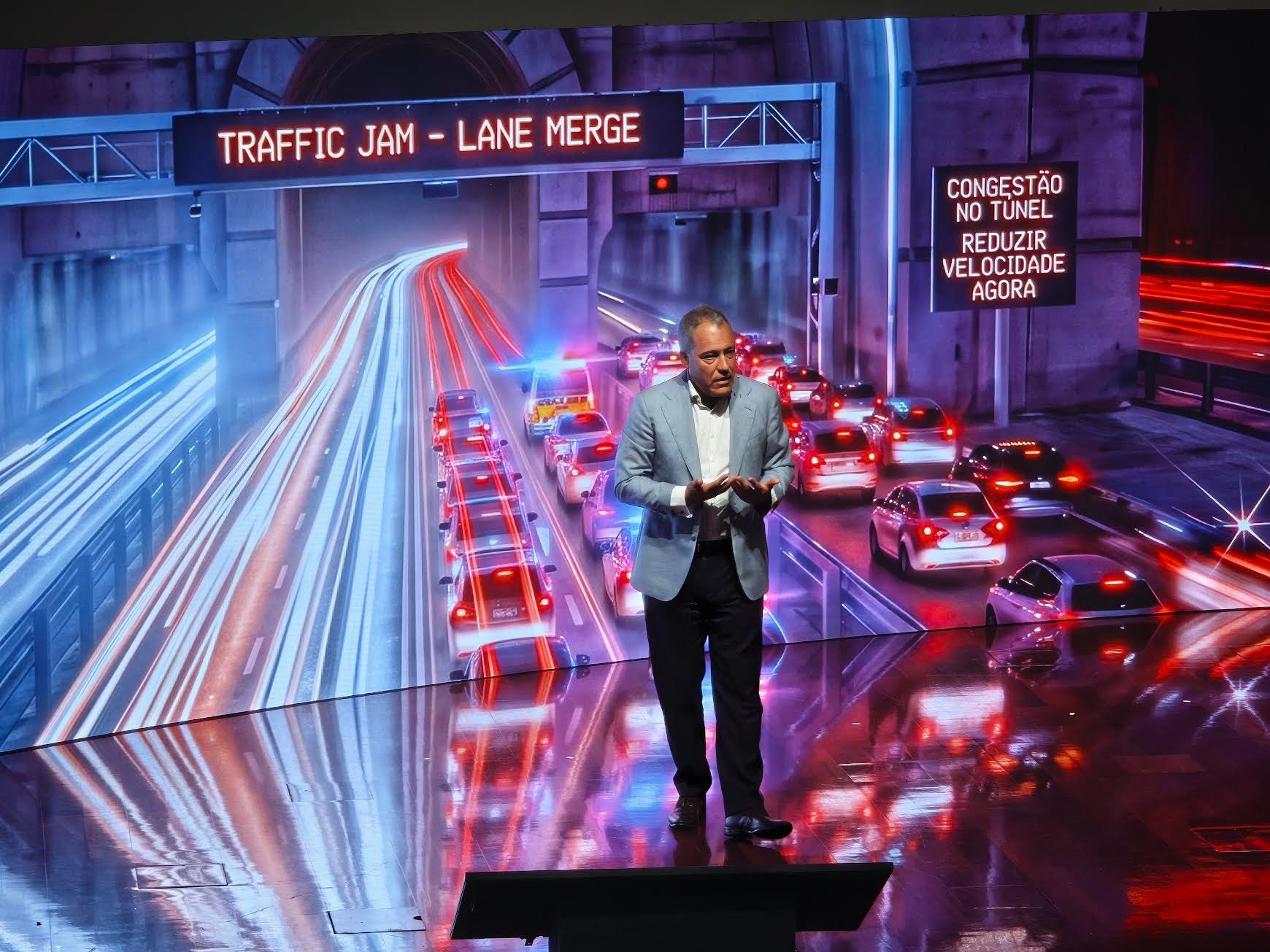
José Tribolet delivered what, for me, was one of the morning’s masterclasses. His framing was wonderfully simple: cars follow rules. People follow rules. Even animals operate within systems of constraints.
AI agents increasingly act in digital environments, yet we have barely begun defining the equivalent rules of the road.
He described something close to a digital Wild West (his expression).
Europe is not starting from zero. The AI Act is already entering enforcement in stages. But even the European Commission acknowledges that regulatory thinking specifically around increasingly autonomous AI agents is still preliminary and evolving.
This, perhaps, is the real tension I took away from Fusion 2026.
The choice is not between being cautious and being bold.
It is between organisations that use caution as a reason to remain in permanent experimentation, and organisations capable of building enough governance, measurement and control to move quickly because they understand the risks.
Road rules did not stop us from building faster cars.
They made faster cars usable.
AI may now need the same transition.