

At the MAAT in Lisbon, and earlier at MoMA in New York, I stood before Calculating Empires, the monumental research-visualisation by Kate Crawford and Vladan Joler.
It is not simply an artwork. It is a vast map of how knowledge, algorithms, and power have intertwined across five centuries to create the technological and political systems we live with today.
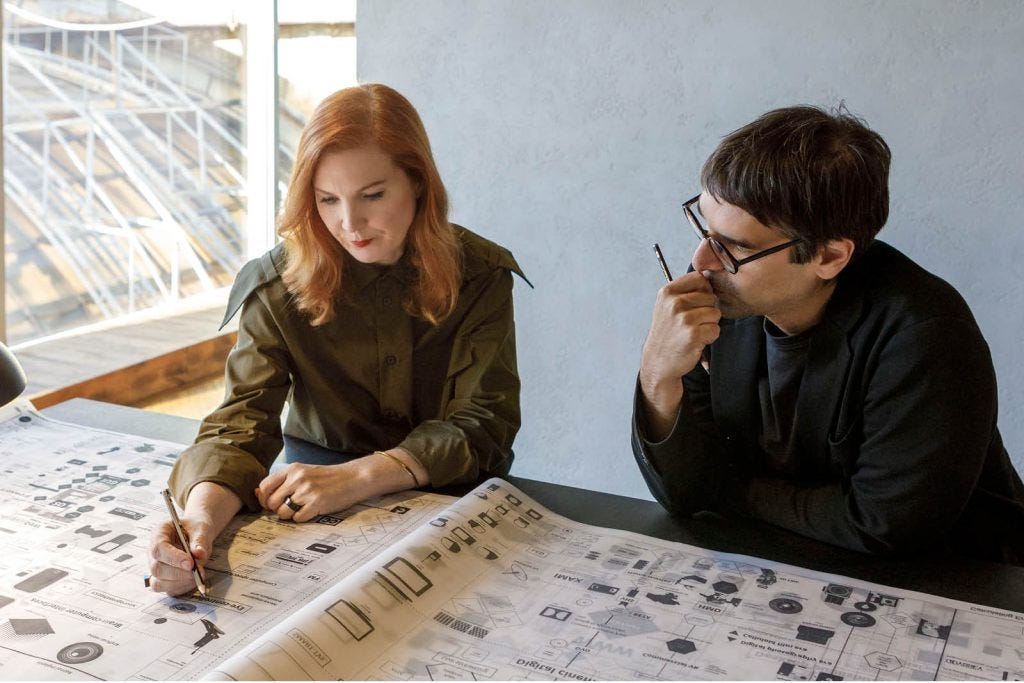
Image: Credits Boghossian Foundation © Patrick Toomey Neri
The work is at once art, history, and critique: it shows how today’s artificial intelligence is not a sudden miracle of code, but the result of centuries of mathematics, classification, communication, and control.
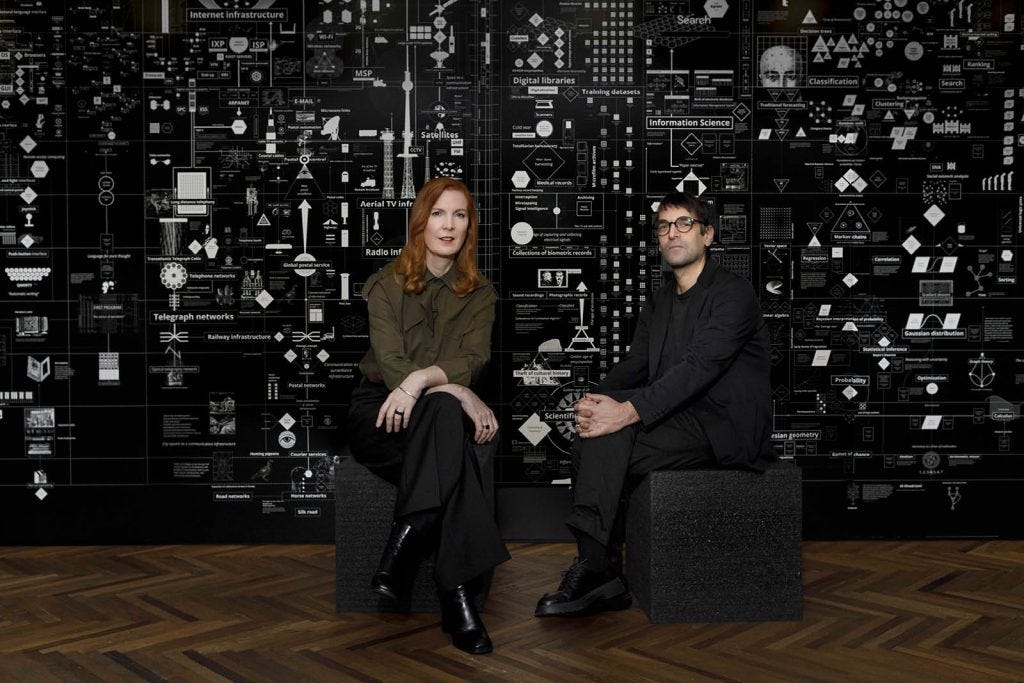
Image: Credits Boghossian Foundation | ‘Calculating Empires’, Fondazione Prada, Milan, 2023-24 © Piercarlo Quecchia
The Long Genealogy of AI
The left side of the diagram begins in the 1500s with the development of Cartesian geometry, games of chance, and probability – the seeds of reasoning about uncertainty.
The 19th century introduced statistics, Gaussian distributions, and Boolean logic, laying the groundwork for the mathematics that would later become the foundations of computing.
The 20th century introduced information theory, Markov chains, and computation itself – the intellectual engines of the digital age.
And finally, the late 20th and 21st centuries saw the arrival of neural networks, machine learning, and generative AI – the technologies we now recognise as artificial intelligence.
Each advance is not isolated: it is part of a long continuum where science, empire, and industry shaped the trajectory of knowledge.
In detail: The Journey of Algorithms and Models
1500–1800: The Foundations
Games of chance and probability appeared when people studied gambling and uncertainty.
Cartesian geometry (1600s) provided a way to describe the world using numbers and shapes.
Calculus and classical mechanics (1700s) built robust tools to describe motion, change, and optimisation.
These ideas were mathematical “engines” for understanding the natural world.
1800–1900: Probability Meets Logic
Statistical inference helped people reason with incomplete information.
Gaussian distributions describe randomness and natural variation.
Linear algebra and vector spaces became the language for solving equations.
At the same time, Boolean logic and binary arithmetic (0/1) prepared the ground for computers.
1900–1950: From Theory to Computation
Markov chains and correlation explained patterns over time.
Information theory (Shannon) described how to compress and transmit data.
The theory of computation (Turing, Gödel) defined what machines can and cannot calculate.
Early sorting, search, and optimisation algorithms appeared.
1950–2000: The Birth of AI
Neural networks were first imagined, though limited by hardware.
Expert systems and symbolic AI tried to encode human reasoning as rules.
Clustering, classification, and ranking algorithms powered search engines and databases.
Decision trees and Bayesian methods aided in forecasting and data-driven learning.
2000–Today: The AI Revolution
Machine learning has become mainstream, fueled by the increasing availability of data and computing power.
Deep learning and transformers (e.g., GPT, BERT) have revolutionised natural language processing and speech recognition.
Generative AI now creates text, images, and music—something once thought impossible for machines.
Forecasting, recommendation, and large-scale neural networks are part of everyday life.
The Big Picture
This chart shows a continuous evolution:
Mathematics gave us the language.
Logic and computation gave us the rules.
Statistics and probability provided us with tools for dealing with uncertainty.
Modern AI combines all of these to create systems that can learn, adapt, and even generate new ideas.
It’s not a sudden invention, but a 500-year journey of human knowledge, each discovery building on the last, leading to the intelligent technologies we use today.
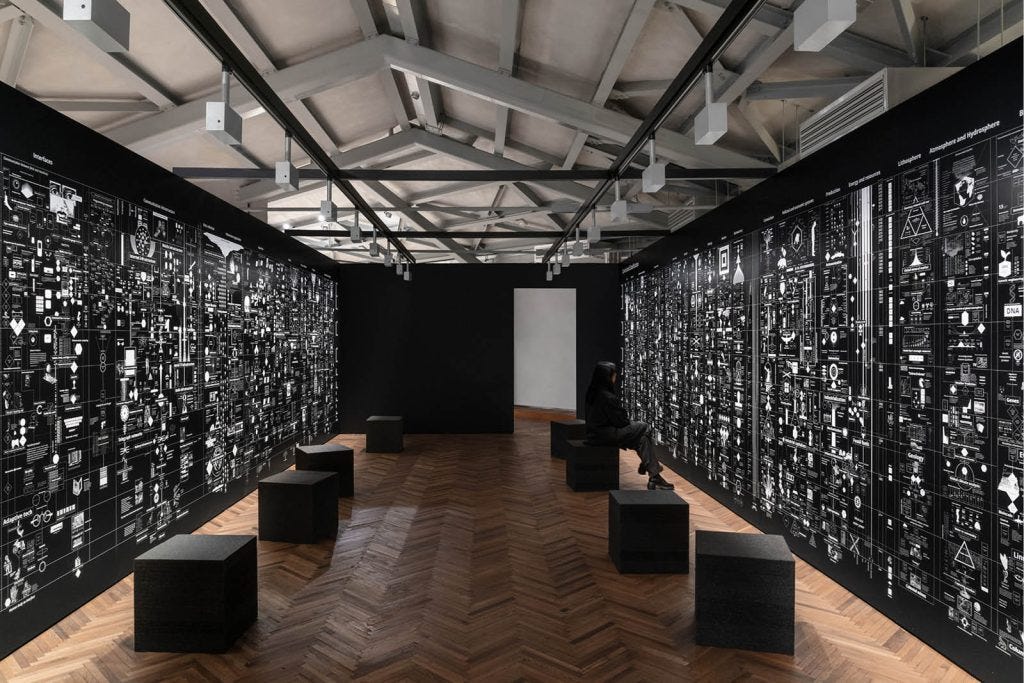
Image: Credits Boghossian Foundation | ‘Calculating Empires’, Fondazione Prada, Milan, 2023-24 © Piercarlo Quecchia
Empire, Control, and Technology
Calculating Empires is about power. It demonstrates how the same tools that enabled progress – probability, statistics, and classification – were also employed in systems of control, ranging from colonial mapping and enclosure to eugenics, surveillance, prisons, borders, and militarisation.
The diagram reveals how empires calculate – and how our current AI systems, powered by vast data extraction and computational labour, echo those histories. This is the art’s most powerful point: AI is not neutral. It is built upon centuries of intertwined logics of knowledge and domination.
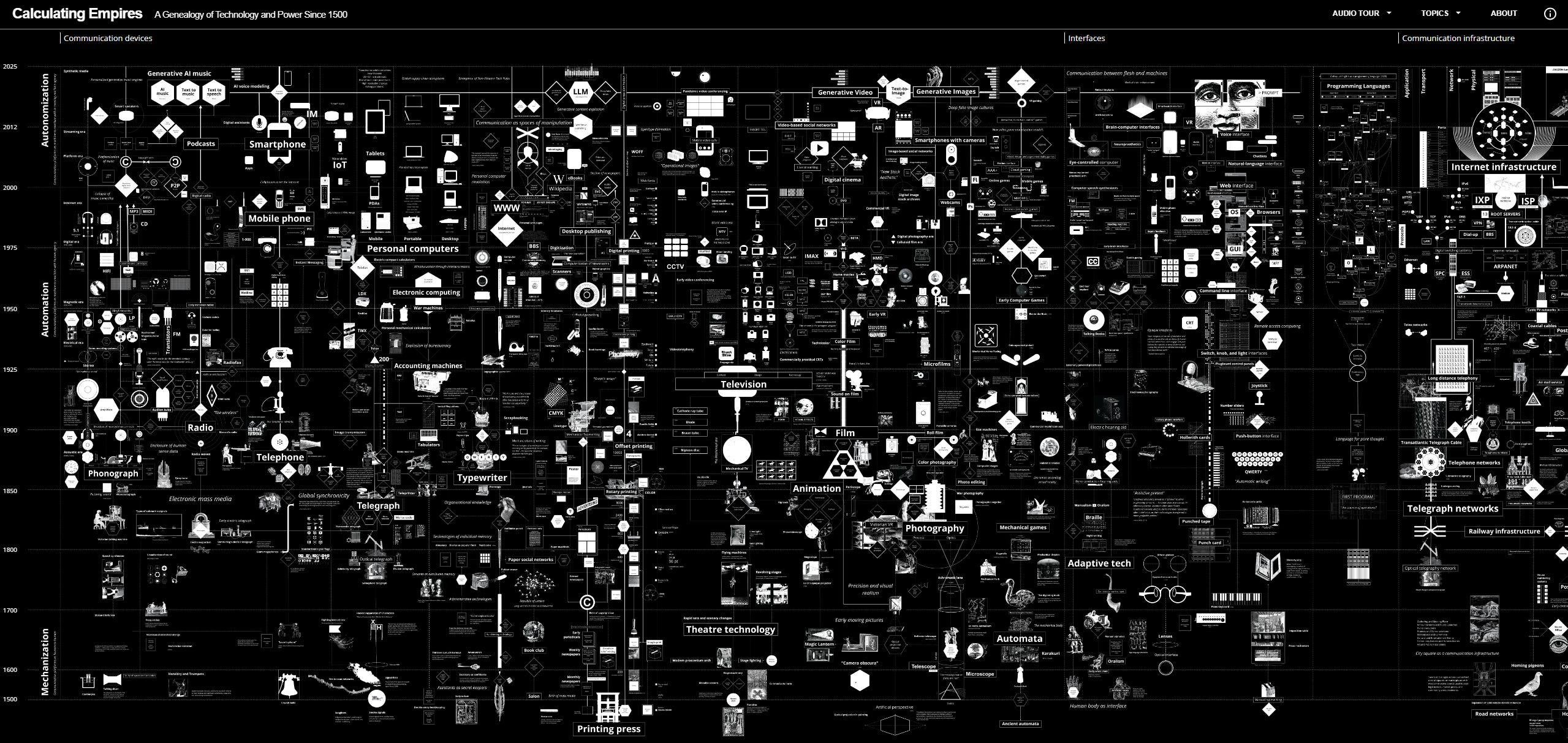
Image: Credits Calculating Empires
In an age where AI is often presented as a purely technical story of innovation, Calculating Empires reminds us that it is also a cultural and political story. It forces us to see that behind every algorithm is a history – and behind every model, a set of values and power structures.
Crawford and Joler invite us to look slowly and carefully across 500 years of diagrams and ideas, to realise that today’s AI is the child of empire, industry, and logic intertwined.
It is an extraordinary act of visual scholarship – a constellation of art, history, and critique – and a reminder that if we wish to imagine fairer futures, we must first reckon with the deep past of our machines.