

Anthropic is one of the most strategically important artificial intelligence companies in the world today.
Founded in 2021 by former OpenAI researchers, including CEO Dario Amodei, Anthropic positions itself as a safety-first AI laboratory. Its core product is Claude, a large language model directly competing with OpenAI’s ChatGPT.
But this is not simply a product competition.
It is a structural shift in how advanced AI is financed, governed and deployed.
Executives tracking AI should not only ask: What is Anthropic?
They should ask: Why is Anthropic strategically different?
Also, read our interview with Haon Park, a researcher at Anthropic
The Technology: What Is “Anthropic AI”?
Anthropic develops frontier large language models. Claude is designed to be:
More steerable
More transparent
Less prone to harmful outputs
Better aligned with human intent
The company pioneered a technique called “Constitutional AI” — a training method in which models critique and refine their own responses using a defined set of principles, rather than relying solely on human feedback.
This approach reduces dependence on large human labelling teams and creates a scalable governance layer.
For organisations deploying AI in regulated environments — finance, defence, healthcare — this matters more than marginal improvements in creativity.
Anthropic’s bet is simple:
The AI company that wins will not be the most chaotic.
It will be the most governable.
That is a fundamentally different thesis from Silicon Valley’s historical “move fast” doctrine.
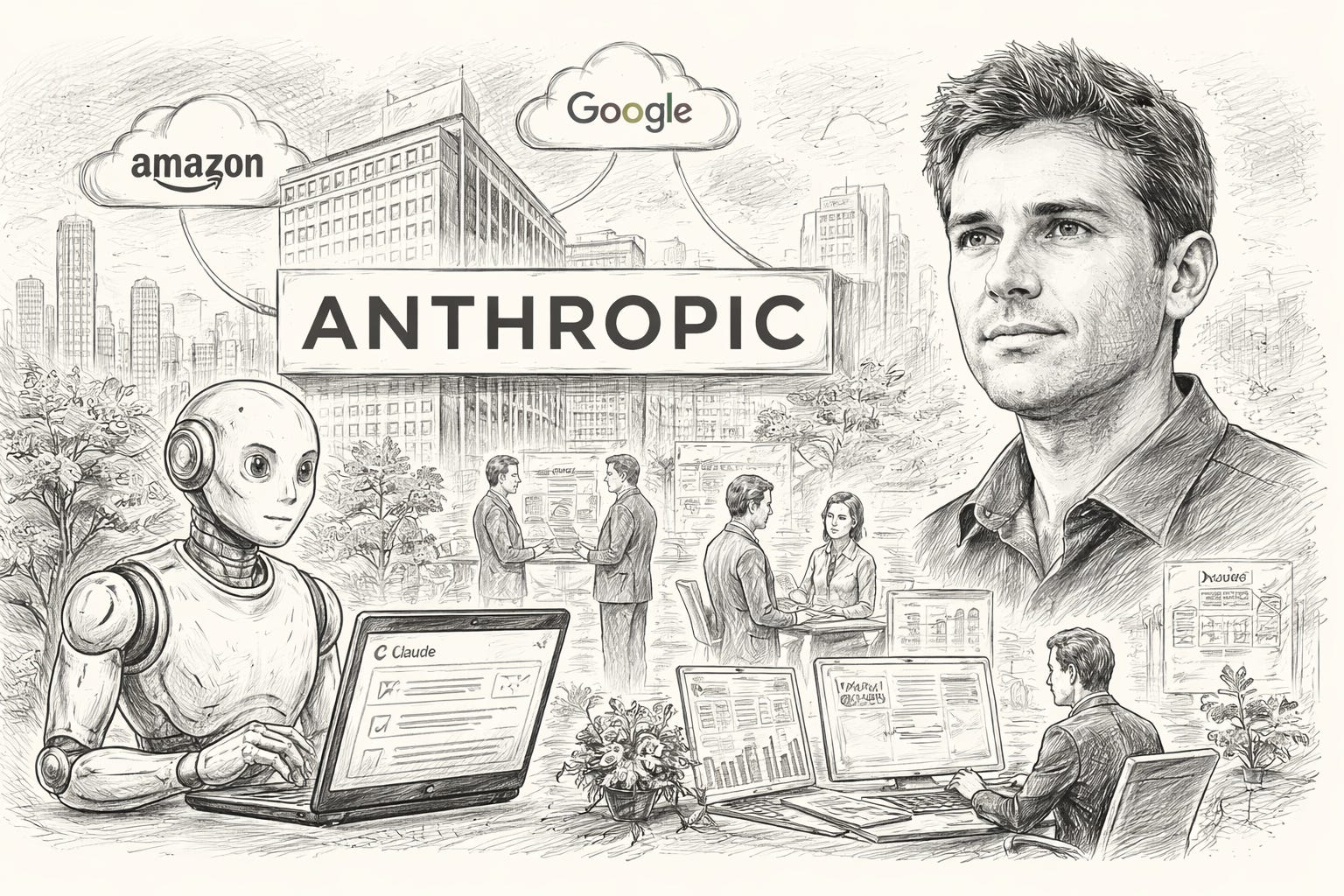
The Capital Structure: Why “Anthropic Stock” Is Trending
Anthropic is not publicly traded. There is no retail “Anthropic stock”.
Yet search interest continues to rise because institutional capital has moved aggressively.
Key investors include:
Amazon — investing up to $4 billion
Google — multi-billion-dollar strategic backing
This is not a passive investment. It is infrastructure positioning.
Amazon integrates Claude into AWS Bedrock. Google provides cloud computing through GCP while also competing directly via Gemini.
This creates a new phenomenon:
Strategic Frenemies at Scale.
Anthropic sits between hyperscalers, extracting capital while maintaining model independence.
For investment professionals, this structure is critical:
Anthropic reduces single-platform dependency risk.
Cloud providers hedge model risk.
Enterprises gain optionality beyond OpenAI.
It is a triangular power balance.
Anthropic vs OpenAI: Governance as Strategy
The comparison with OpenAI is unavoidable.
OpenAI scaled rapidly under Sam Altman, culminating in its deep partnership with Microsoft.
Anthropic emerged partly from internal disagreements about the direction of safety and the pace of governance.
Where OpenAI pursued aggressive deployment, Anthropic emphasised controlled scaling.
The difference is philosophical:
OpenAI ModelAnthropic ModelFast iterationControlled capability releasePlatform expansionAlignment-first designMicrosoft-centric capitalMulti-cloud balancingConsumer scale focusEnterprise + regulated sectors
Neither approach is inherently superior.
But they create different risk profiles.
And risk profile is now a board-level issue.
The Political Layer: Why “Trump Anthropic”?
Artificial intelligence is no longer a purely technological topic. It is geopolitical.
As US elections approach, AI firms are being pulled into national security and political narratives. Defence, misinformation, content moderation and model control are policy flashpoints.
While Anthropic is not publicly aligned with any political figure — including searches linking it to figures such as Donald Trump — its technology intersects with federal policy in three ways:
National AI regulation
Defence applications
Model export controls
Frontier AI companies are increasingly viewed as strategic assets.
Expect increased scrutiny regardless of the administration.
This makes governance architecture not just a brand position — but a regulatory moat.
Claude AI: Why Enterprises Are Quietly Switching
Claude’s growth has been less theatrical than ChatGPT’s. But among enterprises, traction is accelerating.
Why?
Longer context windows
Strong performance on structured reasoning
Lower perceived reputational risk
Integration flexibility via AWS
In corporate environments, the most valuable AI is not the flashiest.
It is the least embarrassing.
That distinction rarely makes headlines — but drives procurement decisions.
The “Core” Question: What Is Anthropic’s Real Asset?
Not the model.
Not the computer.
Not even the capital.
Anthropic’s real asset is its credibility in alignment.
In a world where AI failures can erase billions in market value overnight, credibility compounds.
The New York Times recently highlighted how AI labs are racing to scale while policymakers scramble to respond (see reporting at NYTimes.com). The gap between capability and control is widening.
Anthropic is monetising that gap.
It offers a narrative executives can defend internally:
“We chose the safer frontier partner.”
That narrative has balance-sheet value.
Stake, Power and Optionality
Let us step back.
The AI market is consolidating around three power centres:
Microsoft + OpenAI
Google + Gemini
Amazon + Anthropic
Each pairing reflects infrastructure alignment.
But Anthropic is structurally unique because it is:
Not vertically absorbed
Not yet consumer-dominant
Not politically polarising
It occupies the middle.
Middle positions often look weak in tech cycles.
But in infrastructure transitions, they become leverage points.
If regulatory pressure on OpenAI increases, Anthropic gains.
If Google faces antitrust constraints, Anthropic gains.
If enterprises demand multi-model redundancy, Anthropic gains.
It is a convex strategic position.
What Is Anthropic Technology, Really?
Strip away the branding.
Anthropic technology is:
Large-scale transformer models
Reinforcement learning systems
Constitutional alignment frameworks
Safety evaluation protocols
Technically similar to competitors.
Strategically differentiated in deployment philosophy.
This is why the question “What is Anthropic AI?” is slightly misleading.
The better question is:
What kind of AI future is Anthropic optimising for?
Answer: one where scaling is constrained by governance, not just compute.
The Amodei Factor
Dario Amodei is less publicly theatrical than Sam Altman.
But that may be deliberate.
Anthropic’s communications are restrained. Few grand claims. Fewer consumer spectacles.
In volatile markets, restraint signals maturity.
Investors should not underestimate leadership style as a strategic asset.
Narrative volatility translates into valuation volatility.
Stability attracts institutional capital.
The Real Risk
Anthropic’s challenge is simple:
Safety-first positioning only works if capability remains at the frontier.
If Claude falls materially behind OpenAI or Google in performance benchmarks, safety becomes secondary.
Alignment without power is irrelevant.
So the company must solve a delicate equation:
Scale fast enough to compete.
Scale slow enough to remain credible.
That tension defines the next five years.
Why This Matters Beyond AI
Anthropic is a case study in 21st-century corporate architecture.
It demonstrates:
Strategic capital layering
Governance as a Competitive Advantage
Infrastructure diplomacy
Multi-polar AI ecosystems
Executives should not track Anthropic because it is fashionable.
They should track it because it signals the future shape of strategic technology firms:
Less chaotic.
More institutional.
Deeply entangled with state power.
Designed for scrutiny.
The AI race is no longer just about intelligence. It is about control. And on that axis, Anthropic may be the most important company in the room.