

In Benin City, Nigeria, a quiet revolution took place in 2024. Over six short weeks, a group of secondary school students participated in a groundbreaking experiment that may reshape the future of global education. Powered by ChatGPT-4, these students received just 12 after-school tutoring sessions, each lasting 90 minutes. The results? Staggering.
According to a World Bank working paper by M. De Simone et al. (May 2025), the students who used the AI chatbot for tutoring showed progress equal to what would typically take two years in a traditional classroom setting. These findings weren’t limited to chatbot-specific content. Students excelled even on year-end exams covering broader curriculum material, outperforming peers who received no extra help.
Measured Impact: Over the Hump
The chart tells a clear story. The performance curve for AI-tutored students shifted significantly to the right, toward higher scores. While the average peak of students without extra tutoring hovered around the 45–55 mark (on a 0–100 difficulty-weighted scale), those with AI support surged beyond 60. This wasn’t just statistical noise.
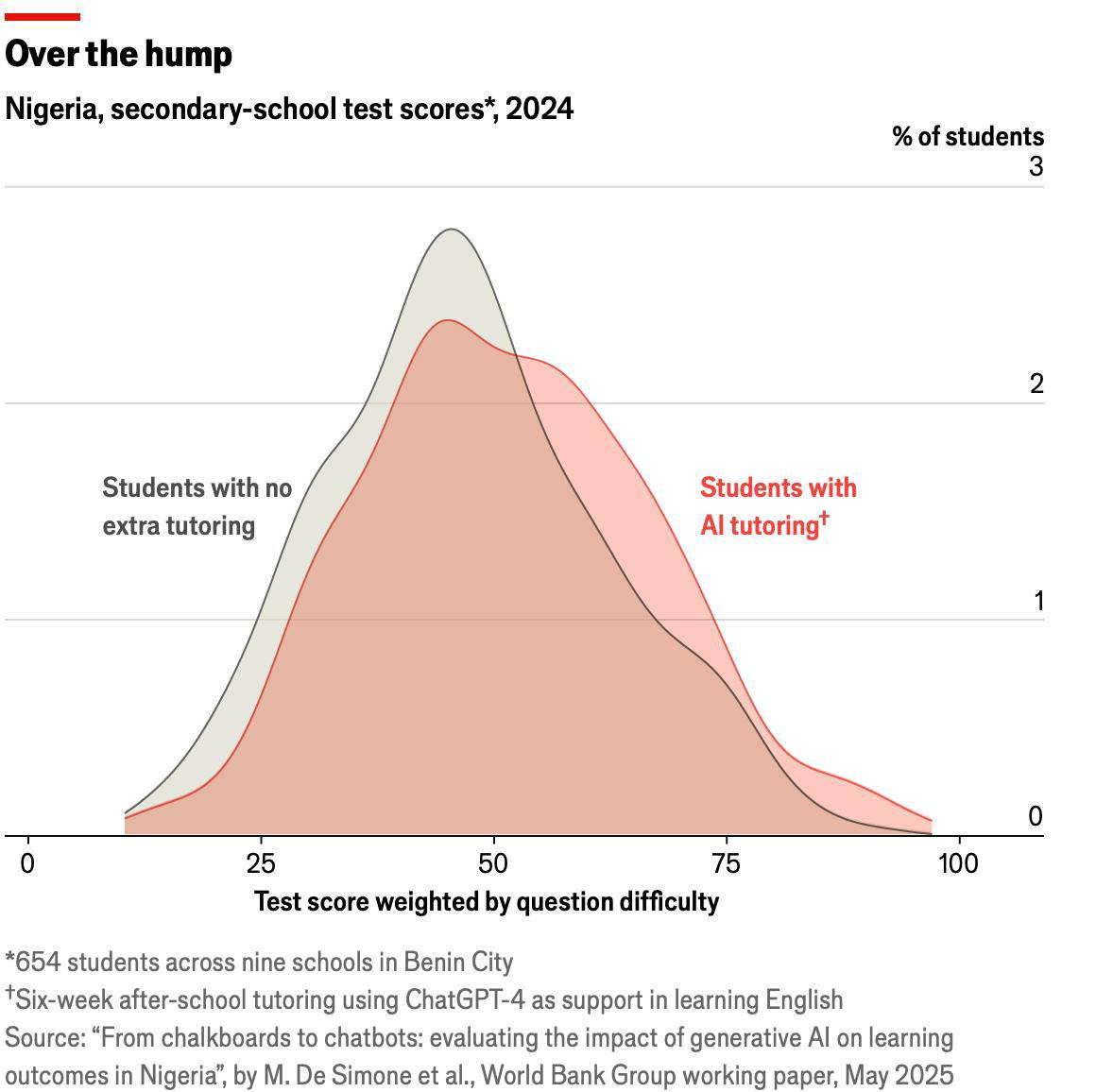
Image: World Bank, 2025
Why This Matters
AI’s effect wasn’t just “better” — it was transformational. This AI tutoring intervention beat 80% of other educational interventions used in low-income countries, including ones backed by trained volunteers from abroad. As the report notes, these gains came despite relatively low teaching baselines, which makes the impact even more compelling.
What’s Behind the Success?
Here’s what made it work:
Consistency: 90 minutes of focused tutoring, twice a week.
Language precision: ChatGPT-4 corrected grammar and guided structured learning in English, a second language for many.
Scalability: Unlike traditional tutoring, one chatbot can guide hundreds, if not thousands, of students simultaneously in a personalised 1:1 relationship.
The AI never got tired. It never skipped class. It offered explanations on demand—something most overburdened teachers can’t.
Caution Without Cynicism
Critics will be right to ask: how generalizable are these findings? Would similar gains show up in countries with higher educational baselines? Perhaps not to the same degree. But that misses the point. In places with limited access to quality instruction, generative AI can level the playing field more quickly and affordably than any known alternative.
What Comes Next?
If tools like LLMs (not only ChatGPT) can provide structured, context-aware tutoring across languages, subjects, and settings, the next billion learners may not be taught by humans at all, at least not entirely.
The real promise isn’t replacing teachers, but augmenting weak systems where human resources are too stretched to deliver. Nigeria’s case is not an anomaly. It’s a wake-up call.