

Software startups are hiring fewer employees. Is AI to blame?
The debate over AI's impact on jobs is heating up, especially in Silicon Valley. Some argue that AI makes work more efficient, enabling smaller teams to accomplish more. Others worry it's replacing jobs outright, particularly in knowledge industries like software development.
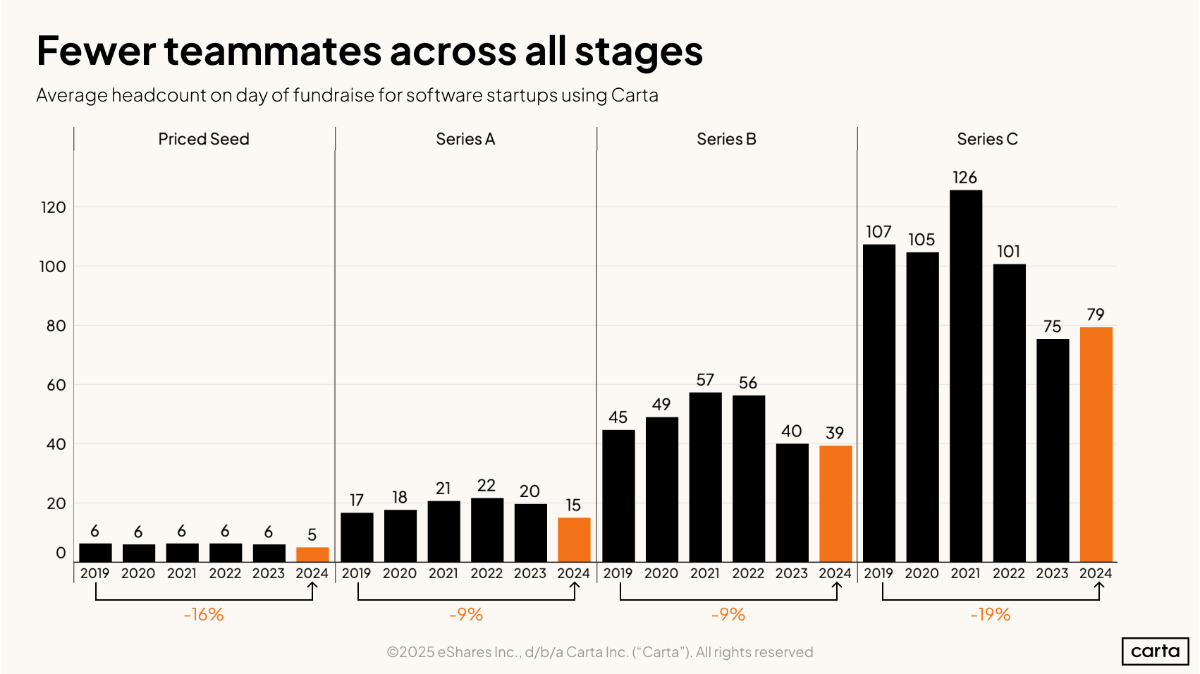
New data from Carta, a platform that tracks startup equity and hiring trends, suggests that startup teams are shrinking. The average size of a software startup raising a Series A round in 2022 was 22 employees. By 2024, that number had dropped to just 15:
Why are startup teams shrinking?
It's tempting to place all the blame on AI (mainly Generative), but the reality is more complex. Several factors are driving this trend:
Venture capital is more challenging to secure. The past two years have seen a pullback in startup funding, forcing companies to be more efficient with capital.
VCs are pushing for higher revenue per employee. Investors want startups to prove they can generate more ARR (annual recurring revenue) with smaller teams.
AI tools are increasing productivity. Many founders admit that AI allows their existing teams to get more done, reducing the urgency of hiring.
AI’s role in reducing startup jobs
While economic factors play a role, AI undeniably reshapes how startups operate. Instead of hiring a large team, many startups are turning to AI-powered solutions:
Code generation tools (e.g., GitHub Copilot, Tabnine) allow smaller engineering teams to ship products faster.
AI-powered customer support (e.g., Intercom’s AI chatbot, ChatGPT-powered assistants) reduces the need for significant support teams.
Automated marketing and sales tools (e.g., Jasper, HubSpot AI) let startups operate leaner while maintaining growth.
Some founders explicitly state that AI enables them to delay hiring—and in many cases, those delays may become permanent.
What does this mean for the future of software jobs?
The shrinking size of startup teams suggests a fundamental shift in early-stage companies' operations. Instead of hiring aggressively, they are prioritizing AI-enhanced productivity. This could mean:
Fewer entry-level roles. If AI can handle routine coding, customer service, and marketing tasks, startups may not need as many junior employees.
More demand for AI-literate talent. Engineers and product managers who understand how to integrate AI into workflows will be highly valued.
A shift in job functions. Instead of hiring for execution, startups may focus on roles that require creativity, strategy, and problem-solving—areas where AI is less effective.
The bottom line
AI isn’t eliminating startup jobs overnight but reshaping hiring trends. The pressure to maintain lean, high-efficiency teams will only grow as automation improves. For startup employees, the key takeaway is clear: AI isn’t just taking jobs—it’s changing what jobs look like.