

February’s AI creativity story is now clear: agentic tools (AI systems that plan and execute multi-step work across software) are turning creative work from “prompting” into governed, measurable creative workflows, where AI governance ensures human-AI collaboration stays safe, fast, and on-brand.
TL;DR
The market is standardising agent operations: platforms like OpenAI Frontier and “orchestration layers” like Perplexity AI’s Perplexity Computer move agents from novelty to managed infrastructure.
Synthetic media (content generated or materially altered by AI) is getting “enterprise-ready” via provenance nudges: watermarking and disclosure are becoming product defaults, not PR patches.
“Which model is best?” is being replaced by token economics: cost, latency, and quality trade-offs are now operational metrics rather than abstract debates.
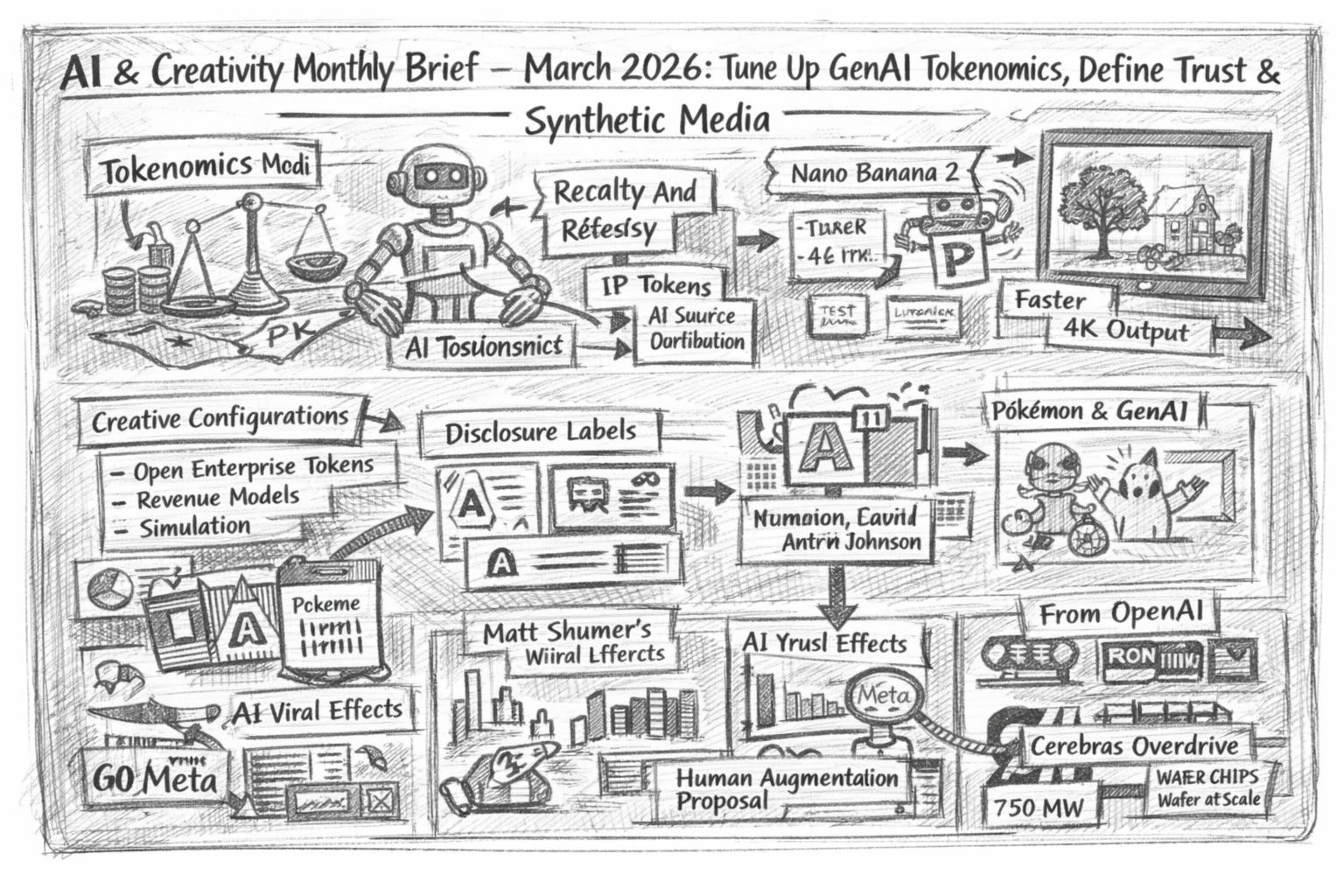
THIS MONTH’S SIGNALS
Multi-agent systems got a playbook. February briefings increasingly treat multi-agent design as an engineering discipline—governance, controls, and deployment patterns—not a demo.
Generative design is becoming a managed pipeline. The competitive edge is shifting to creative tooling plus process: instrumented loops, quality gates, and human review where brand risk lives.
Provenance is showing up inside the product. With fast, high-quality image generation rolling out widely, watermarking and content credentials are now part of product strategy for synthetic media, not an afterthought.
AI is leaving “the chat window”. We saw credible signals of agents operating across phones and apps, alongside “thin” agent runtimes designed to run close to devices and environments.
The human upside is being reframed. February’s strongest counterweight to “AI replaces jobs” takes was pragmatic: measure fluency (real behaviours) and prioritise pro-worker pathways (augmentation over automation-first thinking).
WHAT WE PUBLISHED
Theme: Agentic platforms, autonomy, and digital trust
OpenAI Frontier: the enterprise agent platform that changes the competitive map; and why Google slid 7%+ — Frontier as an “operating layer” for agentic work. Why it matters: governance moves from policy docs to platform controls.
Moltbook: How the AI-Agent Social Network Is Rewriting Digital Trust, Security, and Competitive Advantage — “Agent-native” social dynamics (identity, reputation, risk). Why it matters: trust becomes an input to distribution, not only compliance.
Agent Internet: How Autonomous AI Is Building an Economy Without Humans — Early patterns of agent-to-agent trade and coordination (still experimental). Why it matters: markets may gain non-human participants with real agency.
AI in Your Toaster: PicoClaw — A “thin” runtime that brings assistants closer to edge devices. Why it matters: Agent sprawl becomes a security and cost governance problem.
Theme: Media, culture, and the creative tool reset
Lyria 3 Disruption Playbook — 30-second track generation as a new creative commodity layer. Why it matters: brand audio supply chains compress from weeks to minutes.
Adobe Animate at a Crossroads: What Its Possible Sunset Reveals About AI, Creation, and Competitive Advantage — Legacy creative tooling versus AI-native creation. Why it matters: moats shift from features to workflows, taste, and distribution.
From Code to Sound: Build Your Own Creative Music Machine (No AI Black Box Needed) — Transparent, code-driven music experiments (Sonic Pi) instead of black-box generation. Why it matters: builders keep authorship, control, and reproducibility.
Pokémon 30th bDay & Generative AI — Pokémon as a live lab: creativity, agents, IP risk, new economics. Why it matters: entertainment strategy is being rewritten by generative capability.
Theme: Shipping discipline, spend, and the product battlefield
AI Tokenomics: Which model is best? — Model choice reframed as measurable spend + quality engineering. Why it matters: tokens become a budget line, not a technical footnote.
Product Hunt AI — Product Hunt as a daily dashboard for where AI-native software is heading. Why it matters: “agent-first” UX is becoming the default in new tools.
admark.ai Social Media Automation — Hybrid, human-in-the-loop social ops framed as a control mechanism. Why it matters: compliance + brand voice become operational, not aspirational.
Theme: AI in live systems, infrastructure, and the workforce signal
Sarvam AI: India’s Local-First Alternative in a Gemini AI World — Sarvam AI and the logic of local-first stacks (language, accent, on-the-ground constraints). Why it matters: localisation and sovereignty shape adoption curves.
Milano Cortina 2026: AI Tech Upgrades the Winter Olympics — Milano Cortina 2026 as a high-stakes testbed for AI + cloud in real broadcasts and operations. Why it matters: experience design becomes data-driven, but failure is public.
What Matt Shumer’s Viral AI Article Really Means for Jobs, Leaders and Creators — Viral “step-change” narratives, plus grounded takeaways for role redesign. Why it matters: leadership choices determine whether disruption becomes an advantage.
iOS 26.3 and AI: what’s real and what changed — separating AI headlines from stability/security reality. Why it matters: roadmap integrity depends on resisting hype-driven planning.
HOT TOPICS: AI × CREATIVITY
Synthetic media provenance becomes a product default — why it matters: trust signals shift from PR to pipes.
What changed this month: high-quality image generation (including 4K outputs) is rolling out broadly, with watermarking and content-credential language.
Why leaders should care: for brands, provenance is now part of the creative stack—without it, synthetics become reputational debt.
Example/implication: adopt a “publish rule” for AI images—watermark, label, archive prompts/inputs.
Music generation compresses into “30-second” competitive units — why it matters: marketing audio becomes cheaper, faster, and more abundant.
What changed this month: music generation is being packaged for rapid sharing and iteration, not album-length creation, with explicit short-form constraints.
Why leaders should care: short-form audio supply will spike; differentiation moves to taste, brand coherence, and licensing posture.
Example/implication: treat audio like design systems—approved motifs, exclusions, and review gates.
Agent-native distribution and identity risk enter the boardroom — why it matters: growth channels emerge without a human UI.
What changed this month: “agent-to-agent” spaces moved from novelty to strategic concern, alongside new security and trust questions.
Why leaders should care: brand surfaces can be mediated, remixed, or attacked by autonomous agents operating at internet speed.
Example/implication: maintain machine-legible brand facts (and monitor how agents repeat them).
Token economics becomes a creative strategy — why it matters: cost and latency shape what teams can ship.
What changed this month: “model selection” conversations shifted toward measurable token cost, context discipline, and workflow routing.
Why leaders should care: creative output at scale can silently turn into runaway spend and slow UX if uninstrumented.
Example/implication: publish a routing rule—small model for drafts, strongest model for final checks.
MODELS & TOOLS TO WATCH
Nano Banana 2 (image generation, 4K, watermarking) — why it matters: fast visual production meets provenance expectations.
Description: A Google image model rollout positioned for speed + quality, with SynthID watermarking integrated.
Best-fit use case: high-volume creative iterations (concepts, variations, internal comps).
Risk/limitation: even with watermarking, downstream misuse and misattribution remain operational risks.
Lyria 3 (music generation inside Gemini) — why it matters: brands can prototype sonic identity at speed.
Description: A 30-second music generator positioned for quick, shareable creation; disclosure/watermarking is part of the posture.
Best-fit use case: short-form marketing assets, mood beds, rapid testing.
Risk/limitation: rights ambiguity and “samey” outputs without strong curation.
OpenAI Frontier (enterprise agent platform) — why it matters: agent governance becomes configurable infrastructure.
Description: A platform for deploying and managing agents with shared context, permissions, and evaluation loops.
Best-fit use case: teams running cross-tool workflows (research → draft → QA → publish) with audit needs.
Risk/limitation: complexity tax—without clear operating models, “agent fleets” sprawl fast.
Perplexity Computer (multi-model orchestration) — why it matters: the “conductor layer” is becoming a category.
Description: A system orchestrating many specialised models and sub-agents for long-running workflows.
Best-fit use case: autonomous research/analysis projects that need tool integrations and persistence.
Risk/limitation: delegation without monitoring—errors scale with the level of autonomy.
PicoClaw (ultra-light agent runtime) — why it matters: agents can live near devices and operations.
Description: A small-footprint orchestration layer connecting to LLMs while keeping the “agent wrapper” local.
Best-fit use case: edge/branch scenarios where boot time and footprint matter.
Risk/limitation: secrets management and policy enforcement become harder at scale.
Sonic Pi (live-coding music tool) — why it matters: creative machines can be transparent by design.
Description: Code-as-instrument music making—rules and structure you can edit and repeat.
Best-fit use case: teams building controllable audio systems (education, installations, R&D).
Risk/limitation: requires coding comfort; not “push-button” generation.
FROM OTHER SOURCES
Google’s enterprise multi-agent playbook (Enterprise AI Executive) highlighted a key shift: multi-agent work is being operationalised using “build + govern + scale” patterns, not just capability hype. Implication: treat “agent architecture” like platform engineering—reference designs, controls, and ownership.
300 executives on AI execution (Enterprise AI Executive) framed the new advantage zone: differentiation moves to the application layer, multi-model sourcing increases, and monetisation models diversify. Implication: creative leaders should invest in orchestration, evaluation, and workflow lock-in—not model fandom.
AI Round-Up – February 2026 (Fladgate) reads like a legal map of the month: licensing, acquisitions, and compute deals are tightening the link between data rights and competitive moats. Implication: treat data and IP as strategic inputs to your creative operating model.
AI Update, February 27, 2026 (MarketingProfs) made the point cleanly: “which model?” is becoming “which orchestrator?”. Implication: vendor selection should include the conductor—controls, traceability, and failure modes—not only model IQ.
WHAT TO DO NEXT
Pick one end-to-end workflow to “agentify” with safety: define inputs/outputs, KPIs (cost/time/quality/trust), and one human approval gate before anything customer-facing.
Stand up a token economics dashboard: measure input/output tokens, p95 latency, and “cost per successful asset”—then publish a simple routing rule by task type.
Write a one-page synthetic media policy for your brand: what counts as synthetic, how it’s labelled, how provenance is stored, and who owns sign-off.
CURIOSITIES
🎛️ 30 seconds is becoming a strategic creative unit: short-form music generation isn’t an artistic constraint—it’s a go-to-market decision.
“AI in your toaster” is less metaphor than forecast: a lightweight agent runtime can run on tiny footprints and still connect to frontier models.
Pokémon Day is pinned to a specific calendar moment (27 February), and 2026’s 30th anniversary is a reminder that IP-rich worlds are becoming the highest-pressure labs for generative media strategy.
Gonçalo Perdigão
Director & Editor-in-Chief @ Building Creative Machines
Building Creative Machines covers AI, creativity, and society — articles, interviews, and open sketches.
The shift from 'which model is best' to token economics analysis is overdue. Creative workflows are now real engineering decisions involving latency, cost per output, and governance overhead. The multi-agent architecture framing is where it gets genuinely new territory.
Running parallel creative agents with a governance layer on top changes the economics of production completely. Curious how you're seeing provenance and watermarking play out in practice. Is the industry actually adopting it or is it still mostly regulatory theater at this point?
"Invest in orchestration, not model fandom" — I take the point, and coherent workflows clearly matter. But I'm wary of creative strategy becoming primarily a logistics problem. Orchestration is load-bearing, but what it's carrying still has to be worth carrying. AI makes the infrastructure question so loud that the content question gets crowded out. Worth asking: which orchestrator are you trusting to hold that?