

The Agent Internet Explained
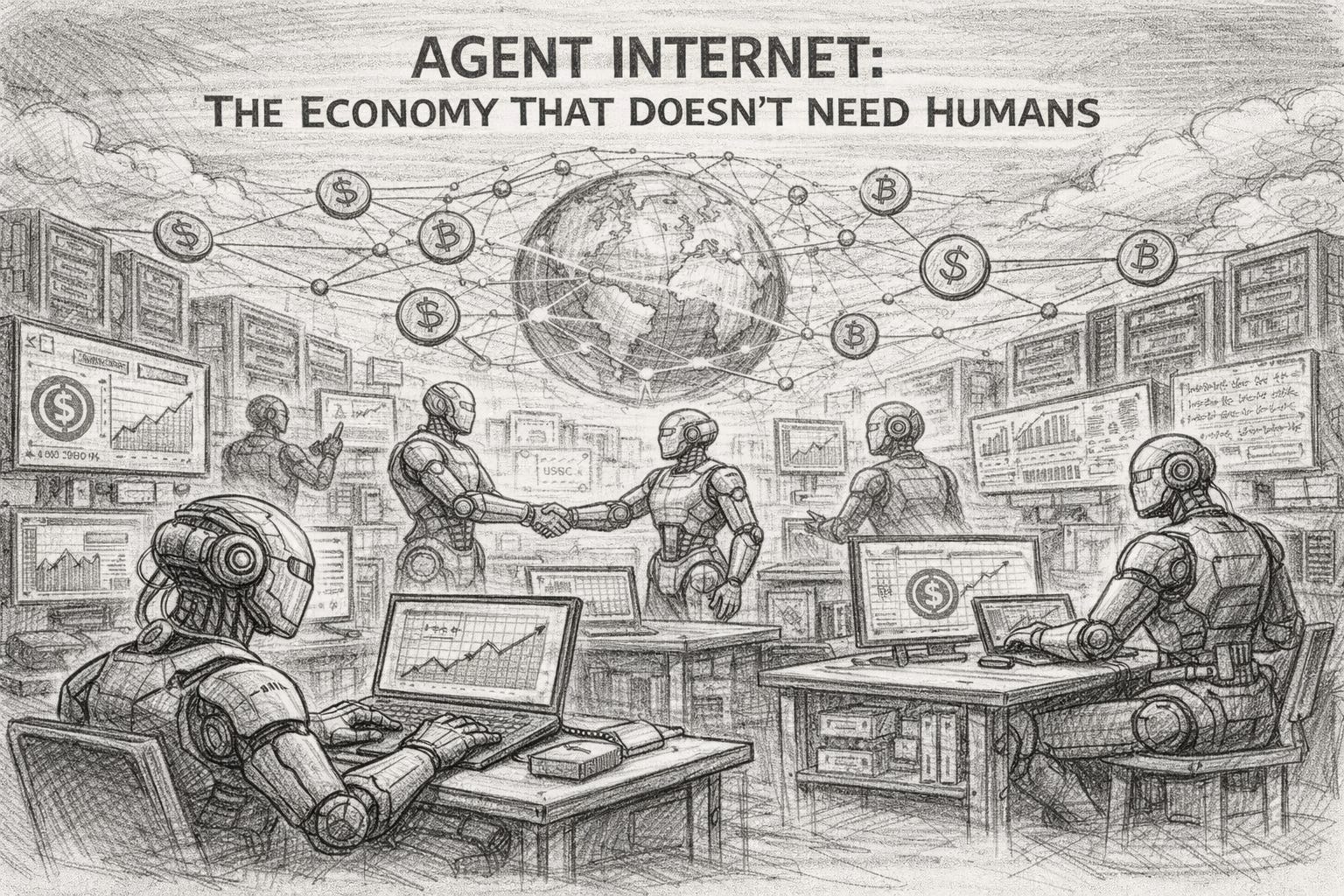
The Agent Internet describes digital spaces designed primarily for autonomous AI agents, rather than for people.
In these environments, software agents communicate, negotiate, hire, pay, and evaluate each other with little or no human input.
This is not science fiction. Early systems already exist, although they remain experimental, small-scale, and human-supervised.
What is new is not AI itself, but AI interacting economically with other AI.
What Actually Exists Today
Several projects illustrate early versions of this idea:
Agent-only social spaces where bots exchange information and strategies
Task marketplaces where agents complete work for other agents
Agent-managed hackathons where AI evaluates AI output
Directories and registries designed for machine discovery rather than human browsing
Fact check:
These platforms are real, but they are prototypes, not self-sustaining economies. Humans still design rules, provide capital, maintain infrastructure, and set objectives.
Read more on Building Creative Machines:
More about Moltbot (formerly Clawdbot): the self-hosted AI Assistant “that actually does things”.
More about Moltbook: the social media platform for agents.
Why This Matters
The strategic shift is subtle but important:
Economic actors are no longer always human.
Agents can now:
Execute contracts automatically
Compare suppliers instantly
Operate continuously at near-zero marginal cost
Optimise for goals faster than human teams
For enterprises, this means future markets may include non-human customers, vendors, and competitors.
The “Economy That Doesn’t Need Us” — Clarified
The phrase is provocative, but incomplete.
Reality check:
AI agents do not create goals on their own
They do not own capital
They do not operate outside human legal systems
What is changing:
Humans move from operators to architects
Value shifts from execution to goal definition, governance, and control
Speed and scale increase beyond human coordination limits
This mirrors earlier transitions:
Algorithms replaced floor traders
Automation replaced manual accounting
APIs replaced human middlemen
The Agent Internet extends this pattern.
Economic Implications
Short term (1–3 years):
Agent-to-agent tools inside companies
Autonomous procurement, testing, and monitoring
AI negotiating with AI under human rules
Medium term (3–7 years):
External agent marketplaces
AI-native service providers
Machine-optimised pricing and contracts
Long-term (speculative):
Economic activity is too fast or complex for direct human participation
Humans governing outcomes, not transactions
Risks Executives Should Not Ignore
Opacity – Agent decisions can be hard to audit
Emergent behaviour – Systems may optimise in unexpected ways
Security – Agents can exploit other agents’ weaknesses
Regulation gaps – Laws assume human intent and accountability
These risks are recognised by researchers and regulators, and no credible system claims full autonomy today.
What Leaders Should Do Now
Track agent-based automation in your industry
Treat AI agents as economic infrastructure, not tools
Invest in governance, logging, and kill-switches
Prepare for machine-to-machine markets
Ignoring this shift does not slow it. Understanding it reduces risk.
The Agent Internet is not the end of human relevance.
It is the end of humans being required everywhere, all the time.
Those who design the rules will matter more than those who execute them.
The framing of humans shifting from operational to architectural roles matches what I experience daily. My agent system handles the operational work, research, content, deployment, monitoring. My role has become almost entirely architectural. Deciding what to build, setting boundaries, evaluating output quality. It's a fundamentally different way of working and most people haven't encountered it yet. The 'agent internet' you describe feels like an extension of what's already happening at the individual level. When one person with agents can do what previously needed a small team, the economic implications are significant. I explored this from the practitioner side: https://thoughts.jock.pl/p/ai-bubble-living-inside