

The rumour, the signal, the strategy
Whispers that Adobe Animate could be nearing the end of its lifecycle have unsettled designers—and should quietly focus executives.
Whether Animate is formally retired, rebranded, or slowly absorbed into a broader platform matters less than why this moment feels inevitable. Mature creative tools are colliding with a new reality: AI-native creation is changing not only how content is produced, but how software value itself is defined.
For C-level leaders and builders, this isn’t a nostalgia story. It’s a strategy memo in disguise.
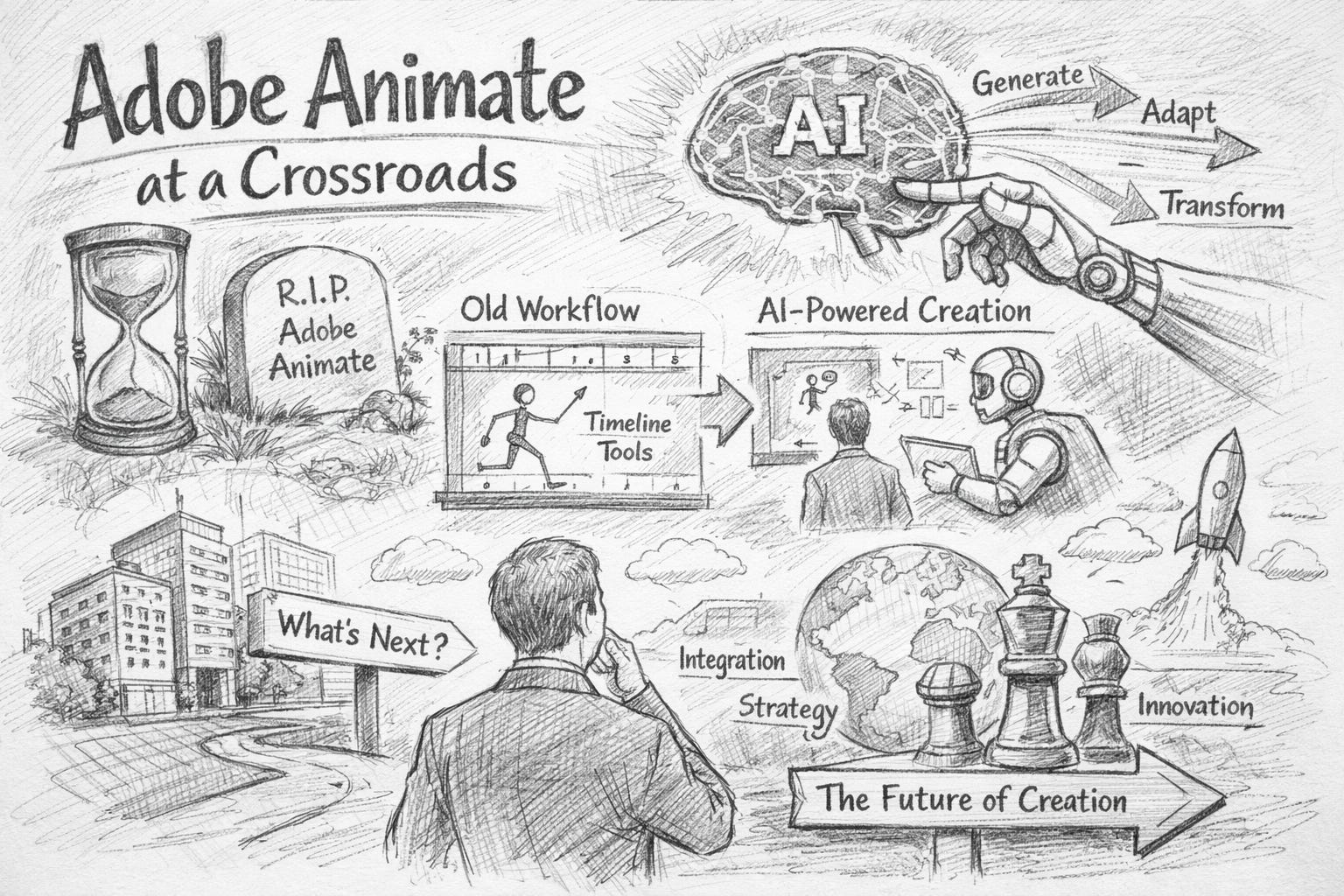
Adobe Animate was built for an era AI is dissolving
Adobe Animate (née Flash) excelled in a world where:
Timelines were handcrafted
Motion required technical literacy
Creativity scaled linearly with human effort
That world is ending.
Generative AI compresses ideation, execution, and iteration into a single loop. Motion, interaction, and even narrative logic can now be suggested, generated, and remixed in seconds. The competitive edge no longer comes from mastering tools—but from orchestrating systems.
Animate’s challenge is not quality. It’s a paradigm mismatch.
The AI paper underneath this moment
At the core of AI disruption is a structural shift:
Tools are no longer endpoints. They are intermediaries.
AI transforms software from:
Feature-based → Outcome-based
Skill-gated → Intent-driven
File-centric → Model-centric
In this model, value migrates upward:
From “who can animate”
To “who can direct, validate, and deploy intelligence”
Legacy creative tools struggle here—not because they lack AI features, but because they were never designed to be co-pilots.
Why Adobe (and everyone else) is consolidating
For Adobe, the strategic logic is clear:
Fewer standalone tools
More integrated, AI-augmented platforms
Deeper data moats across workflows
From a boardroom perspective, Animate looks less like a product and more like a capability—one that can be embedded elsewhere or deprecated without killing the value it once delivered.
This is not a retreat. It’s a consolidation ahead of an AI arms race.
What builders and innovators should actually learn
If Adobe Animate fades, the lesson isn’t “don’t invest in creative tools.”
It’s this:
AI-native beats AI-enhanced
Retrofitting intelligence is weaker than designing around it.Creative leverage now compounds nonlinearly
Small teams with models outperform large teams with workflows.Your moat is not software mastery
It’s taste, judgment, distribution, and speed of learning.Products must survive intent abstraction
If users can say what they want instead of how, your product must still matter.
The quiet question every executive should ask
If a flagship tool like Adobe Animate can feel obsolete—not broken, not bad, just outpaced—what does that imply about your own stack?
AI doesn’t kill products.
It reveals which ones were context-dependent.
Animate’s possible sunset is not a failure.
It’s a signal flare.
Those who read it early will build what comes next.
Those who don’t will polish timelines while the market moves on.