

admark.ai: the practical “human-in-the-loop” play for social media that doesn’t sound like a bot
Most companies have the same social media problem, just dressed in different clothes:
Marketing can’t ship consistently without sounding generic.
Sales wants content that drives real conversations, not vanity likes.
Compliance wants fewer surprises.
Leadership wants a system, not another “we should post more” meeting.
admark.ai’s pitch is blunt: AI drafts fast, humans finish properly, and you get posts in minutes, not days. On its own, that sounds like every AI tool. The difference is the operating model: admark.ai explicitly positions itself as a hybrid workflow in which content is manually reviewed and refined by experienced writers/journalists, rather than left as raw model output. It also emphasises EU-style data handling: processing on German servers, GDPR positioning, and “no training on your data” claims. (More on why that matters in board-level terms.) (source: admark.ai)
Why this is showing up now (and why it’s not just “another scheduling tool”)
Scheduling tools solved “posting on time.” Generative AI solved “blank-page anxiety.” Neither solved “brand risk + performance discipline.”
A lot of firms tried the obvious path: “Let’s use ChatGPT, and we’ll tidy it up.” That typically fails in three ways:
Voice drift: you get technically correct text that still doesn’t sound like you.
Sameness: platform algorithms and audiences increasingly punish templated content.
Process debt: teams spend more time arguing about outputs than shipping.
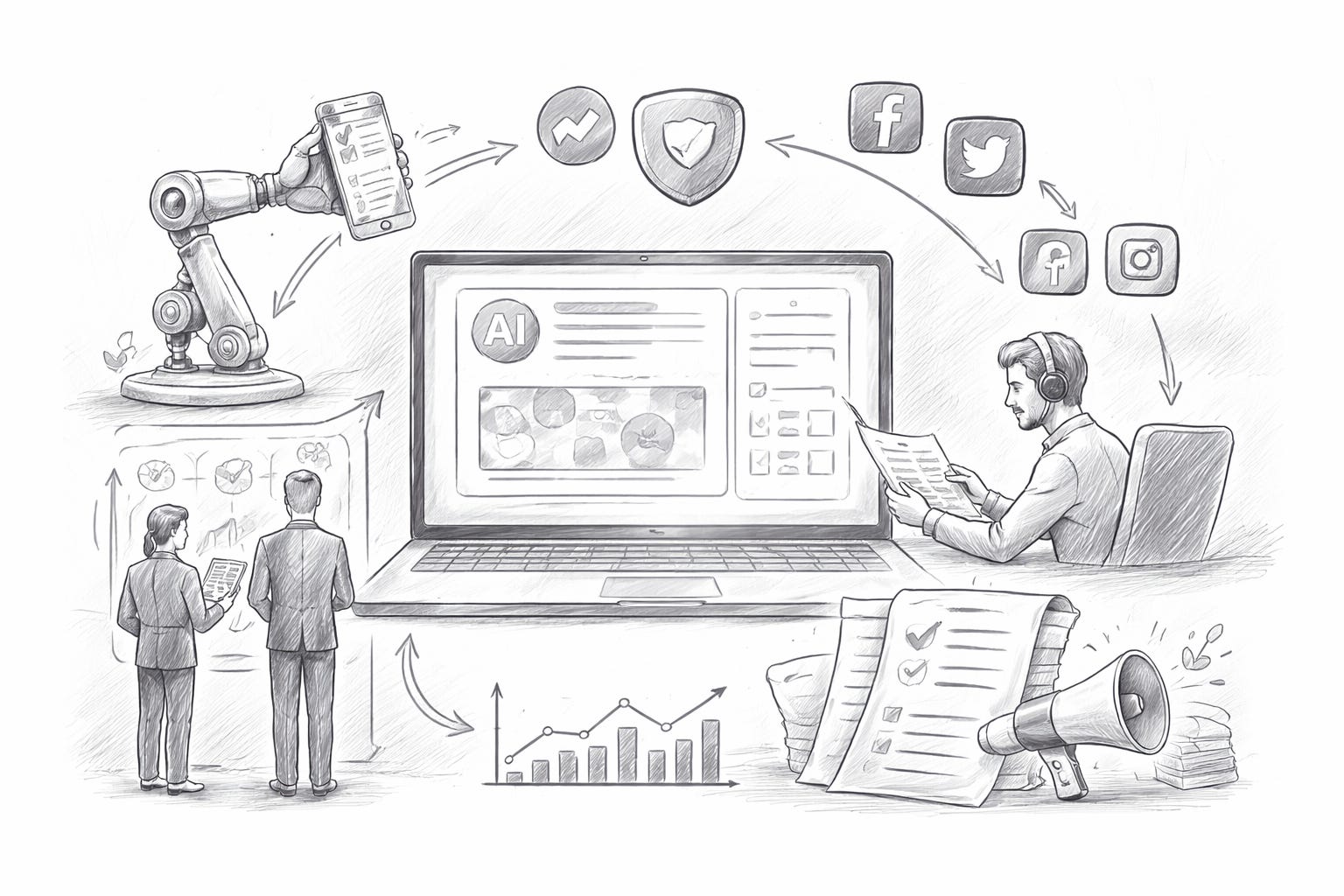
admark.ai is essentially packaging a repeatable content operating system: draft quickly, apply brand constraints, and put a human quality gate in the loop before anything goes live. That’s not a philosophical point; it’s a control mechanism.
If you want a neat label for it: Human-in-the-Loop (HITL)—a design pattern widely discussed in AI systems that uses human judgement to steer outcomes and reduce risk.
What admark.ai actually appears to do
From its own onboarding and product language, admark.ai positions itself as a platform that:
helps you generate posts (and publish/schedule them),
can use your company information and files as a context window to produce more specific content,
supports team workflows (invite employees, employee advocacy),
aims to analyse and optimise content rather than only generating it.
But the sharper message is on the front door: “Only a few clicks to your first post,” “created in ~15 minutes,” “0% AI clichés,” and, crucially, a human “expert” refines the AI draft.
That combination is strategically interesting because it reframes social content as a semi-managed service layer rather than merely a tool. If you’re deciding whether to trial it, evaluate it as you would any operational outsourcing: quality controls, turnaround time, and feedback loops.
Content is not the asset, the loop is the asset
Most firms treat social posts as outputs. The better framing: social posts are probes. Each post is a cheap market test:
What language triggers comments from buyers (not peers)?
Which objections appear repeatedly?
Which proof points land without discounting?
The winning teams don’t “post more.” They build a loop:
publish → 2) observe → 3) extract signal → 4) update messaging → 5) publish again.
admark.ai’s “autopilot” ambition is basically: make that loop cheap enough to run every day.
If you’re in a leadership seat, the KPI you should care about isn’t “number of posts.” It’s:
Time-to-learning (how fast you turn engagement into a clearer go-to-market story)
Cost-per-iteration (how cheap it is to test new angles)
Compliance latency (how long it takes to approve content safely)
A practical due diligence checklist before you adopt admark.ai
1) Decide what you want to automate: production, distribution, or optimisation
Many tools automate distribution. Fewer automate quality.
A simple internal test:
If posting more often would harm your brand today, you don’t have a distribution problem.
You have a quality-control problem.
admark.ai is clearly trying to sit in that quality-control space with its hybrid model.
2) Pressure-test “brand voice” with three uncomfortable prompts
Run a pilot using content that usually breaks generic AI:
A regulated claim (finance, health, legal nuance)
A “why us” story with real trade-offs
A customer objection that sales hears weekly
If the outputs stay specific, grounded, and consistent, good.
If they become vague, inspirational, or buzzword-heavy—stop.
3) Ask where your data goes, in operational terms (not marketing terms)
admark.ai claims German server processing, GDPR alignment, and that your topics and posts remain private, are deletable on request, and are not used for training.
That maps nicely to European expectations for data protection governance (and to the wider legal framework within which organisations operate). For a sanity check on what “good” looks like at the policy level, compare it against official EU data protection framing and principles, such as transparency and accountability. Do not treat this as paperwork, treat it as risk pricing.
EU legal framework overview: European Commission – EU data protection legal framework (European Commission)
UK principal reference (useful even for EU firms operating in the UK): ICO – lawfulness, fairness, transparency (ico.org.uk)
4) Measure the editing time, not the writing time
The hidden cost in content is “stakeholder edit cycles.”
Track:
minutes spent editing per post
number of approval touches
number of “brand/compliance rewrites”
If admark.ai reduces edit cycles, it’s saving real money—even if the subscription looks expensive compared to “free AI.”
5) Build a “message bank” as you go
Every time a post performs, extract:
the hook
the proof point
the objection handled
the call to action that worked
Within 30 days, you’ll have a messaging asset your competitors don’t: a bank of tested language.
Where admark.ai fits best (and where it doesn’t)
Best fit
B2B services and mid-market firms that need steady, credible thought leadership without hiring a full in-house team.
Founder-led brands where voice matters, but time is scarce.
Regulated-ish categories where fully autonomous AI output is a reputational risk.
Poor fit
Brands whose differentiation is purely visual (fashion/editorial-heavy) unless the tool’s media workflow is central to your strategy.
Teams that already have a strong editorial engine and only need distribution automation.
Organisations that can’t commit to reviewing outcomes and building a learning loop (you’ll underuse it).
Hybrid beats “autonomous” for public-facing brand work
The industry hype swings between two extremes: “humans do everything” vs “AI does everything.” The reality in brand-facing work is closer to aviation: autopilot is great, but you still want trained oversight.
HITL systems aren’t a compromise. They’re a design choice to keep speed and quality. Academic and industry discussions on HITL consistently highlight its value in producing more effective human–machine collaboration outcomes.
admark.ai is selling that choice in a very specific domain: social media.
If you trial it, don’t judge it on whether it can write a decent post. Lots of tools can.
Judge it on whether it can help your organisation do three hard things at once:
ship consistently
stay on-brand
learn faster than competitors
That’s where the compounding returns are.