

Agentic AI is transforming from a promising technology into an indispensable part of enterprise strategy. Unlike traditional AI, which excels at specific, narrow tasks, agentic AI autonomously manages and executes entire processes, thereby significantly reducing the need for human intervention. With an expected economic value generation of up to $450 billion by 2028 (main source: Rise of agentic AI, CapGemini, July 2025), business leaders must act swiftly to leverage this competitive edge.

Main Source: Rise of agentic AI, CapGemini, July 2025
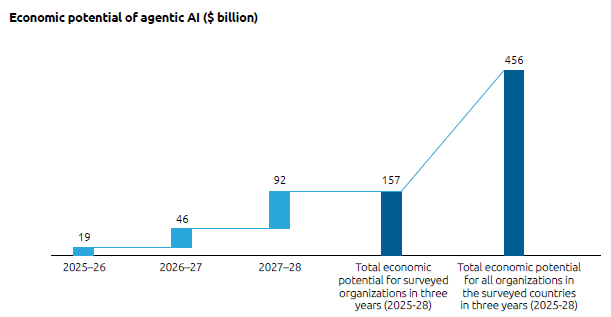
Image: Economic Potential of Agentic AI. Rise of agentic AI, CapGemini, July 2025
KPIs: Current Adoption and Impact
As of 2025, adoption of AI agents is rapidly expanding, with 14% of organisations already deploying them partially or at full scale. Nearly one-quarter (23%) have launched pilot projects, and 61% are actively exploring or preparing for deployment.
While full autonomy remains rare, approximately 15% of processes are expected to be semi-to-fully autonomous within a year, rising to 25% by 2028.
Early adopters are already seeing impressive results:
Efficiency improvements of 10–30% in structured processes.
Productivity boosts equivalent to saving 10 minutes per hour worked.
Anticipated cumulative economic benefits of approximately $19 billion within the next year, scaling up to $92 billion annually by the third year.
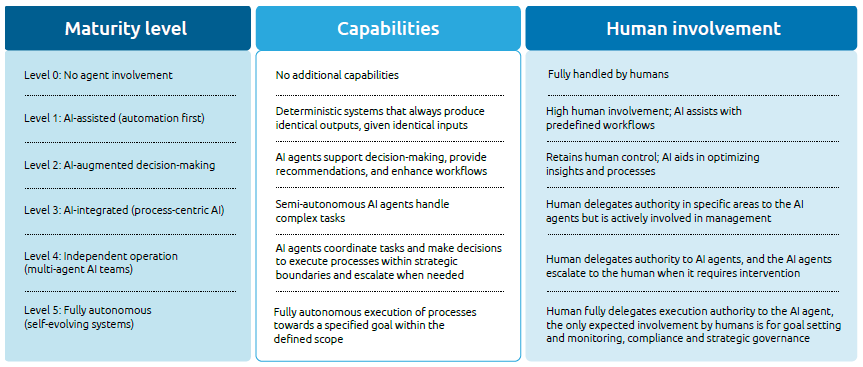
Image: What are the levels of autonomy in AI agents? Rise of agentic AI, CapGemini, July 2025
Strategic Trends Shaping the Future of Agentic AI
1. Growing Autonomy, Measured Trust: While businesses acknowledge agentic AI’s potential, trust remains cautious, especially regarding full autonomy. Trust in fully autonomous agents has decreased notably, from 43% to 27%, within one year. Businesses are opting for AI models that combine autonomy with strategic human oversight to mitigate risks and build reliability.
2. Widespread Enterprise Integration: AI agents are set to expand most aggressively within customer service, IT, and sales departments, subsequently penetrating deeper into operations, R&D, and marketing. This phased expansion aligns autonomy levels with process complexity and risk management strategies.
3. Shift to Collaborative Teams: By 2028, AI agents will routinely function as integral team members in human-supervised workflows. This collaborative approach is vital for maximising transparency, efficiency, and employee acceptance.
4. Data and Ethical Foundations: The significant challenge of data readiness persists, with fewer than 20% of organisations reporting robust data infrastructures. Addressing data governance, security, and ethical AI practices is crucial for scaling and ensuring compliance with evolving regulatory standards.
5. Customisation through Strategic Partnerships: Most organisations (62%) prefer partnering with established solution providers (Salesforce, SAP, ServiceNow) for agent deployment due to integration ease and immediate operational readiness. Simultaneously, there's a clear preference (55%) for consumption-based pricing models, providing cost efficiency and scalability.
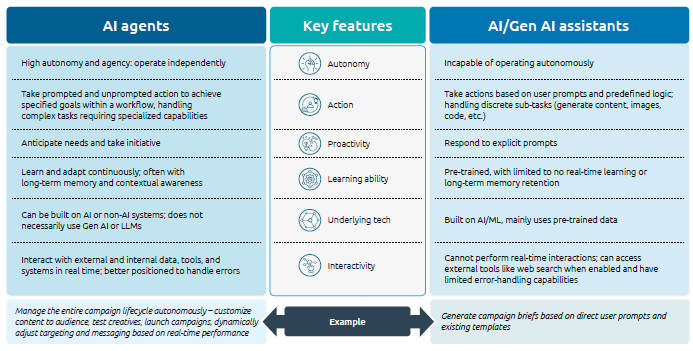
Image: How do AI agents differ from AI/Gen AI assistants? Rise of agentic AI, CapGemini, July 2025
Recommendations
To effectively navigate and benefit from the agentic AI revolution, organisational leaders must:
Clearly define autonomy boundaries and human oversight roles.
Invest aggressively in data infrastructure and AI readiness.
Prioritise transparency and ethics to build internal and external trust.
Foster strategic partnerships and flexible pricing models to optimise investment.
By aligning strategy, resources, and ethical frameworks now, business leaders will capitalise on agentic AI's substantial promise, transforming processes, improving performance, and securing long-term competitive advantages.