

Over the past ten years, AI startups have raised over $650 billion in venture capital, marking a significant shift in the investment and technology landscape. But how has the industry evolved, and what should businesses and investors watch for in the future? With insights drawn from global data, let’s dive into how AI venture capital deals and exits have transformed and what this means for investors looking ahead.
Tracking the Growth of AI Venture Capital
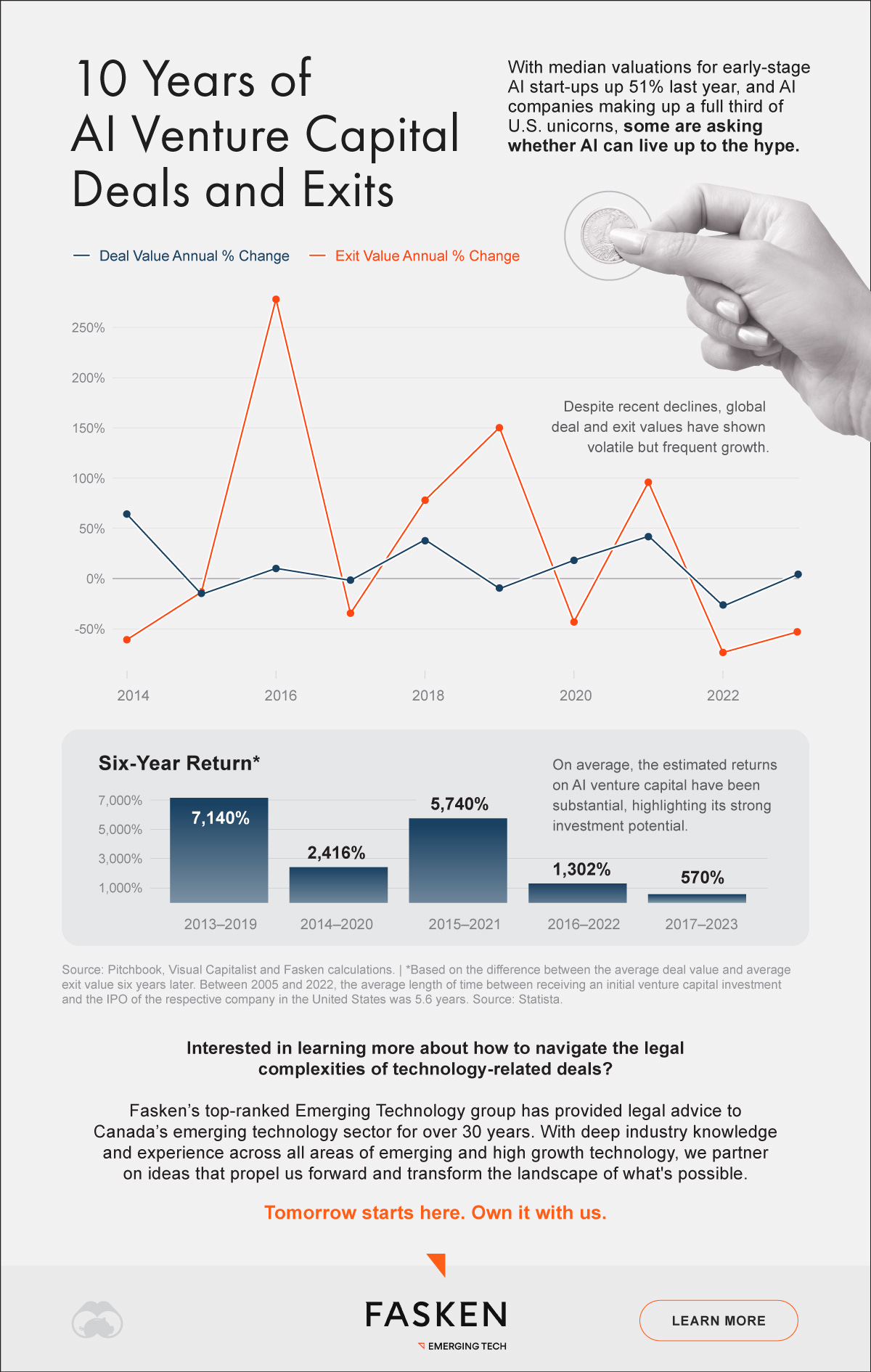
From 2013 to 2021, the world saw exponential growth in AI venture capital activity. Deal values surged as the potential for AI technology became more apparent, with average deal sizes climbing from $4.8 million in 2013 to $15 million by 2021. In parallel, exits—when AI startups go public or are acquired—also showed impressive returns, peaking at an average value of $386.7 million in 2021.
However, the past few years have brought fluctuations. 2022 marked a 27.3% drop in average deal values, while 2023 saw a modest recovery with a 4.2% increase, lifting the average deal value to $11.4 million. Exit values have been on a sharper decline, plummeting from their 2021 high to just $48 million by 2023—a 53.1% drop.
Despite these recent dips, the AI sector remains a robust investment opportunity, especially when viewed through the lens of long-term growth. The industry’s steady rise in deal volume until 2021 points to a long-lasting appeal for investors, though today's landscape requires a more discerning eye.
AI's Investment Potential: High Risks, Higher Rewards?
To assess venture capitalists' potential returns, the data assumes a six-year holding period—a typical timeframe for investments to mature before companies either exit or go public. During this period, AI investments delivered phenomenal returns. For instance, investments made in 2013 yielded an astonishing 7,140% return by 2019, highlighting the sector’s explosive growth in its early days.
However, returns have gradually declined since the period ending in 2021. By 2023, the six-year return rate had fallen to 570%. This volatility signals that while AI continues to hold vast potential, investors must be increasingly selective. The days of throwing capital at every AI startup are over. Instead, the focus will likely shift to backing companies that offer clear technological differentiation, scalability, and viable business models.
Why This Matters for Businesses and Investors
AI’s initial hype may be cooling, but this is not the time to shy away from the sector. On the contrary, the recent slowdown in deal and exit values could be a blessing in disguise for both investors and AI-focused businesses. Here’s why:
Higher Quality Deals: With investors becoming more selective, the quality of AI startups that receive funding is set to improve. Companies with robust technology, clear use cases, and proven business models will rise to the top, offering more reliable paths to profitability.
Market Resilience: Despite the dips, AI remains at the heart of innovation across industries—from healthcare and finance to manufacturing and retail. Technology is becoming more integrated into everyday operations, creating ongoing demand for AI solutions and investment.
Strategic Opportunities: As the market becomes more discerning, businesses have an opportunity to carve out a niche. AI companies that can demonstrate tangible results, scalable solutions, and strong leadership will have the upper hand in securing funding and gaining market share.
Navigating the Future of AI Investment
Although the high-flying returns of AI investments have tempered, savvy investors can still find value in the sector by focusing on quality over quantity. Venture capital firms will increasingly back startups that have cutting-edge technology and demonstrate real-world applications and clear paths to profitability.
According to recent data, AI investment has already been a critical driver of growth in venture-backed company valuations in 2024, with over 60% of the U.S. market’s growth attributed to AI investments in the first half of the year alone. This underscores AI’s continued relevance and potential despite the recent cooling of returns.
For investors and businesses alike, the message is clear: AI’s golden age of investment is not over; it is merely evolving. By being selective, focusing on strategic opportunities, and backing the right companies, there remains significant potential for solid returns in the years to come.
Conclusion: What the Future Holds
The AI venture capital landscape has experienced extraordinary growth over the past decade, though it now faces an adjustment period. While returns have been volatile in recent years, AI remains one of the most transformative forces across industries, and there is still immense potential for those who can navigate the market wisely. For businesses and investors, the key will be to focus on high-quality, scalable startups that have the potential to deliver sustained value, even in a fluctuating market.
Data source: Visual Capitalist