

2025 Was a Brutal Year for AI
2025 was not a gentle year for artificial intelligence. It was intense, noisy, over-hyped, over-funded, over-criticised and profoundly transformative.
Foundation models became commodities. Costs dropped fast. Capabilities jumped faster. Regulation entered the room. Boards stopped asking “what is AI?” and started asking “why aren’t we moving faster?”
It is almost a tradition in our industry to close the year with predictions for the next one. Everyone does it. Most are wrong. Some are directionally useful.
Based on the book we wrote, more than 50 exclusive interviews with world-class experts, over 200 articles published, and thousands of pages read, debated and challenged, we want to do the same.
Not because we think we are infallible.
But because in one year’s time, we will be here to be held accountable 🙂
Below are our seven predictions for 2026.
1. Robots Will Scale Fast, Especially Humanoids
Hardware finally catches up with software
AI software is already extraordinary. The bottleneck has been the physical world.
That changes in 2026.
Humanoid robots will move from demos to deployment. Not everywhere, but in factories, warehouses, hospitals, logistics hubs and large facilities.
Why now?
Vision, planning and control models are mature
Simulation + reinforcement learning reduces training costs
Capital is flowing aggressively into robotics startups
Examples already visible:
Humanoids learning tasks in simulation before touching the real world
Robots trained once and deployed thousands of times
Physical labour is becoming “software updatable”
For executives, this is not about science fiction.
It is about labour shortages, safety, cost predictability and 24/7 operations.
Robots will not replace all humans.
They will replace tasks humans no longer want to do.
2. Agentic AI Will Explode, Especially Buying Agents
The beginning of eCommerce disruption
2026 will be the year of Agentic AI: systems that don’t just answer, but act.
The most disruptive category?
👉 Agents with the ability to buy on our behalf.
Imagine:
An AI agent that understands your preferences, budget and constraints
It compares products, negotiates prices, places orders and manages returns
It learns continuously from your behaviour
This changes everything:
SEO becomes “Agent Optimisation”
Brand matters less than trust and machine readability
Marketplaces compete for AI agents, not humans
We are moving from:
“How do we attract customers?”
to
“How do we convince their agents?”
For leaders in retail, marketplaces and consumer brands, this is an existential shift, not a feature update.
3. Cyber Defence Becomes AI-First
Because attackers are already using AI
AI-powered cyber attacks are already here:
Automated phishing at scale
Real-time social engineering
Adaptive malware
In 2026, defence will fully embrace AI—not as a tool, but as the core layer.
Expect:
Autonomous detection and response
AI systems fighting AI systems
Security teams augmented, not replaced
The key shift is speed.
Humans cannot react in milliseconds. AI can.
For boards and CISOs, the question is no longer “should we use AI in cyber?”
It is “can we afford not to?”
4. 2026 Will Show Real Productivity Impact
Not pilots. Not experiments. Results.
For years, AI productivity gains were promised but hard to measure.
That changes in 2026.
Why?
AI moves from copilots to workflows
Agents handle end-to-end processes
Internal tools outperform generic ones
We will see:
Fewer people doing more high-value work
Faster decision cycles
Entire middle layers automated
The most significant gains will not come from replacing people, but from removing friction:
Less coordination
Less reporting
Less manual work
Productivity will finally show up in P&Ls, not just keynote slides.
5. The Impact on Jobs Becomes Clearer
Destruction, transformation and creation—at the same time
The debate about AI and jobs has been emotional and polarised.
In 2026, it becomes more concrete.
We will clearly see:
Some roles disappearing
Many roles transforming
New roles are emerging fast
What changes most is not employment numbers, but skill composition.
Growing demand for:
AI-literate managers
System designers
Human-AI orchestrators
The safest professionals will not be the most technical, but the most adaptable.
For leaders, workforce strategy becomes a core AI strategy.
6. Big Tech and AI Companies Will Double Down on Equity
Talent, control and long-term bets
Cash compensation matters less in AI.
Equity matters more.
In 2026:
Competition for elite talent intensifies
Equity becomes the primary lever
Strategic acquisitions accelerate
Why?
The value is long-term
The upside is asymmetric
Control of IP and teams is critical
We will see:
Aggressive acqui-hires
Minority stakes in frontier startups
Ecosystems built through ownership, not partnerships
This is not a bubble behaviour.
It is a platform war.
7. Marketing Enters the Age of Hyper-Personalisation at Scale
One-to-one, finally achievable
AI removes the trade-off between personalisation and scale.
In 2026:
Every message can be personalised
Every journey is dynamically generated
Every customer is treated as a segment of one
Examples:
AI-generated creatives per user
Real-time adaptation across channels
Continuous experimentation at near-zero cost
Marketing becomes:
Less intuition
More systems
More relevance
The winners will not be the loudest brands, but the most context-aware.
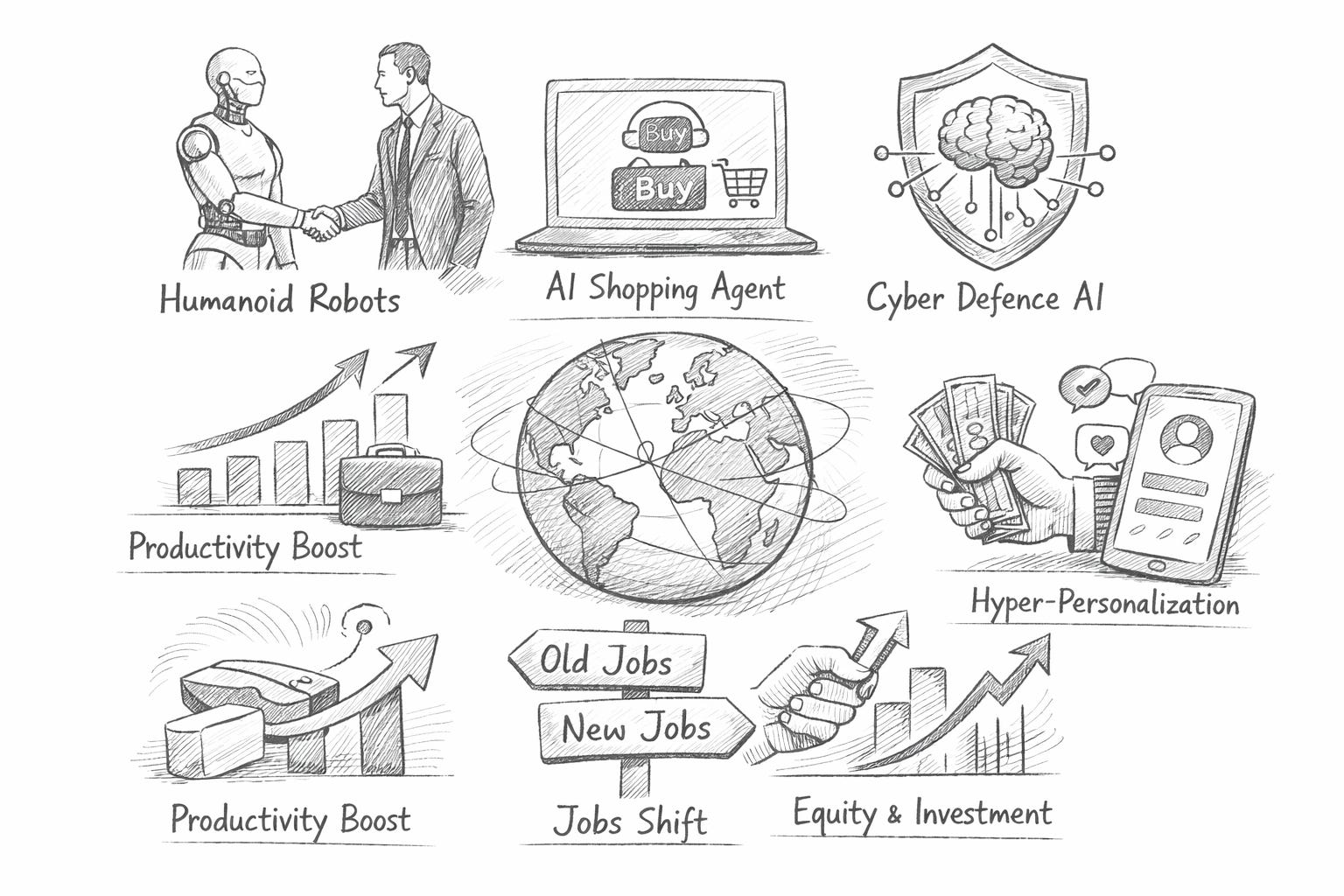
Image: by ChatGPT. We also predict that image generators will soon be smart enough to design exactly seven predictions, without repeating one of them 🙂
Final Thought
Predictions are easy. Accountability is harder.
These seven shifts are not speculative. They are already visible; 2026 is when they compound.
We believe we are moving from creative machines to economic machines.
Let’s revisit this in one year.
We will be here.