

I stumbled upon this infographic online, and honestly, it’s a gem. It breaks down 40 AI terms in the simplest way possible – no jargon, no tech-speak, just straight-to-the-point definitions. If you’ve ever found yourself nodding along when someone says “large language model” or “zero-shot learning” (while secretly thinking, “uh, what?”), this is for you.
What I like about this chart is that it’s not just a glossary – it’s a roadmap to understanding how AI works, how it’s evolving, and how we can use it.
Let’s dive into a few terms that stand out and connect the dots.
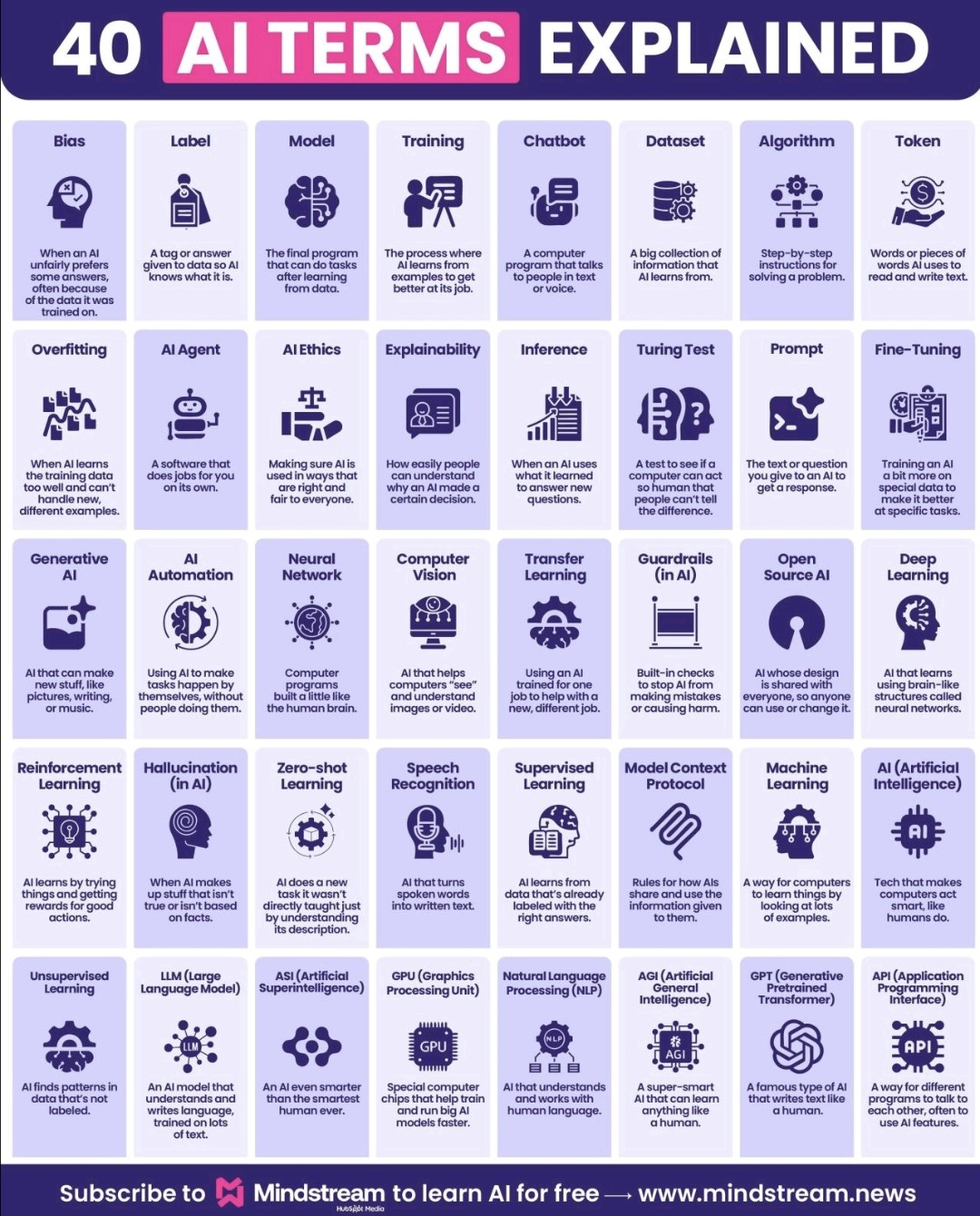
1. Bias, Datasets, and Labels – The Foundation
AI is only as smart (or as fair) as the data it’s trained on. The term “bias” here is a polite way of saying that AI can sometimes favour certain individuals or make unfair decisions, simply because it was trained on biased data. As leaders and entrepreneurs, this is where your values kick in. If you’re building products or services powered by AI, understanding bias is critical. Otherwise, you risk alienating customers or, worse, making harmful decisions.
If you’re building products or services powered by AI, understanding bias is critical
Bias comes directly from datasets – the huge collections of information that AI learns from – and labels, which are the tags we give to that data so the AI knows what’s what. Imagine teaching a kid what “cats” are by only showing them orange tabby cats – they’d think every cat must be orange. Same problem.
2. Models and Training – Where the Magic Happens
A model is essentially the brain of an AI system. But this brain doesn’t just appear out of nowhere – it needs training. Training is the process by which AI learns by example, much like an apprentice learning from a master craftsman. The better the examples, the smarter the AI.
Here’s where fine-tuning comes in. Fine-tuning is like giving that apprentice a speciality – instead of learning every skill under the sun, they get really good at one specific thing (e.g., writing ad copy or designing a logo).
3. AI That Talks Back – Chatbots, Prompts, and GPT
We’ve all chatted with bots, whether on customer service websites or through AI tools like ChatGPT. A chatbot is exactly that: a computer program that talks to you. What makes today’s chatbots powerful is prompt engineering – the art of asking the AI the right question or providing it with the right context to elicit the best response.
GPT (Generative Pretrained Transformer) is mentioned here, and if you’ve used ChatGPT or similar tools, that’s the tech under the hood. Think of it as the ultimate conversation partner – trained on massive amounts of text to sound human.
4. Generative AI – The Creator’s Playground
For creatives, Generative AI is the game-changer. Whether it’s writing, art, music, or even video, generative AI can create something new out of thin air. Pair that with AI automation, and suddenly you’ve got machines doing the heavy lifting – from drafting your social posts to editing your product videos.
5. Neural Networks, Deep Learning, and Computer Vision
Neural networks are inspired by the human brain, and deep learning is like their higher education. These are the tech frameworks that let AI recognise faces, understand speech, or predict which ad a user is most likely to click.
Throw computer vision into the mix, and AI suddenly “sees.” It can scan photos, understand videos, and make sense of the visual world. For brands and startups, this means smarter tools – from auto-tagging products to creating interactive AR experiences.
6. Guardrails – Because AI Needs Boundaries
The infographic mentions “guardrails” – built-in checks to prevent AI from doing something dumb or harmful. This is such an underrated point for leaders. Just because AI can do something doesn’t mean it should. The companies that win in AI will be the ones that combine innovation with responsibility.
7. The Future Words – AGI, ASI, and LLM
Towards the bottom, things get wild. AGI (Artificial General Intelligence) is the idea of AI that can think and learn like a human. ASI (Artificial Superintelligence)? That’s the next step – AI that’s smarter than us. We’re not there yet, but it’s no longer science fiction.
In the meantime, LLMs (Large Language Models) are what we’re all using right now. They’re what makes ChatGPT, Claude, or Gemini tick. They don’t just “search” – they create.
What This Means for You
If you’re a leader, entrepreneur, or creative, AI isn’t a tech trend to watch from the sidelines – it’s the toolset of the future. The better you understand these terms, the more confidently you can:
Innovate faster – by spotting opportunities AI can handle for you.
Lead smarter – by asking the right questions of your tech teams.
Create boldly – by collaborating with AI, not fearing it.
This infographic is a great starting point, but the real magic happens when you experiment. Try prompting a chatbot to brainstorm ideas, or test a generative AI tool for your next project.